Trade Show Marketing Strategy: How to Stand Out from the Competition
Trade shows put you in front of buyers who are ready to act. 82% of attendees carry purchasing authority, and nearly half are already in the final stages of a buying decision. But with hundreds of exhibitors competing for the same attention, showing up with a booth and a handshake is not a strategy. The companies that win at trade shows are the ones that treat every phase of the event, from pre-show planning to post-show follow-up, as a coordinated marketing effort.
At Xibit Solutions, we’ve spent over 20 years helping exhibitors design and build booths that draw traffic and generate leads at shows like CES, SEMA, SHOT Show, and MAGIC. This guide covers the strategies that consistently separate high-performing exhibitors from the ones who blend into the background.
Why Trade Shows Still Outperform Other Marketing Channels
Trade shows are one of the few marketing channels where your audience self-selects for buying intent. According to a 2026 industry report, exhibitors report an average return of $4 for every $1 invested, and 88% of businesses exhibit at trade shows specifically to raise brand awareness or launch new products.
The economics also favor in-person meetings. A face-to-face meeting at a trade show costs roughly $142 on average, and the average cost per lead at trade shows is about $112, which is lower than most digital marketing channels.
These numbers matter because they frame the opportunity. Every trade show is a sales environment where the right strategy can produce measurable pipeline in a compressed timeframe.
Start Planning 4 to 6 Months Before the Show
Early planning is one of the most impactful moves an exhibitor can make, and it is also one of the most overlooked. Companies that begin show planning four to six months in advance secure 34% better booth locations and book 41% more pre-show meetings than those that start just weeks before.
| Planning Timeline | Booth Location Advantage | Pre-Show Meetings |
|---|---|---|
| 4 to 6 months before show | 34% better placement | 41% more appointments |
| Within 6 weeks of show | Baseline | Baseline |
Here is what early planning should cover:
- Set specific, measurable goals. “Generate leads” is not a goal. “Collect 100 qualified leads from procurement managers” is. Define targets for demos, meetings, and lead quality before you book floor space.
- Choose the right shows. Not every trade show is worth the investment. Pick events where your target buyers will be, and prioritize shows where you can secure a location with strong foot traffic.
- Lock in your booth design early. Custom-designed booths require lead time for fabrication, graphics production, and logistics coordination. Starting early means you get the booth you want, not a rushed compromise.
Pre-Show Promotion That Fills Your Calendar
The work of attracting visitors starts weeks before the show floor opens. Exhibitors who invest in pre-show outreach consistently generate more booth traffic than those who rely on walk-by traffic alone.
Effective pre-show tactics include:
- Targeted email campaigns to your prospect and customer lists, announcing your booth number, featured products, and any show-only offers
- Social media teasers using the event’s official hashtag, behind-the-scenes content from your booth build, and previews of what attendees will see
- Pre-booked meetings with high-priority prospects using event apps or LinkedIn outreach, so your most important conversations are confirmed before you arrive
Cvent recommends sharing teaser posts, using a unique hashtag, and posting live updates during the show to extend your reach beyond the physical venue.
Booth Design That Pulls Traffic from the Aisle
On a crowded show floor, you have about five seconds to convince someone walking by that your booth is worth their time. That first impression is almost entirely visual. 48% of exhibitors say eye-catching displays are the single most important factor for drawing foot traffic.
Graphics and Signage
Your booth’s graphics are doing most of the selling from a distance. A few principles that consistently work:
- Lead with a clear, bold tagline that communicates what you do, visible from at least 20 feet away. Attendees scanning from the aisle will not stop to read a paragraph.
- Use high-contrast colors and large-format visuals that match your brand identity. Consistent branding (colors, fonts, logos) helps attendees recognize you instantly.
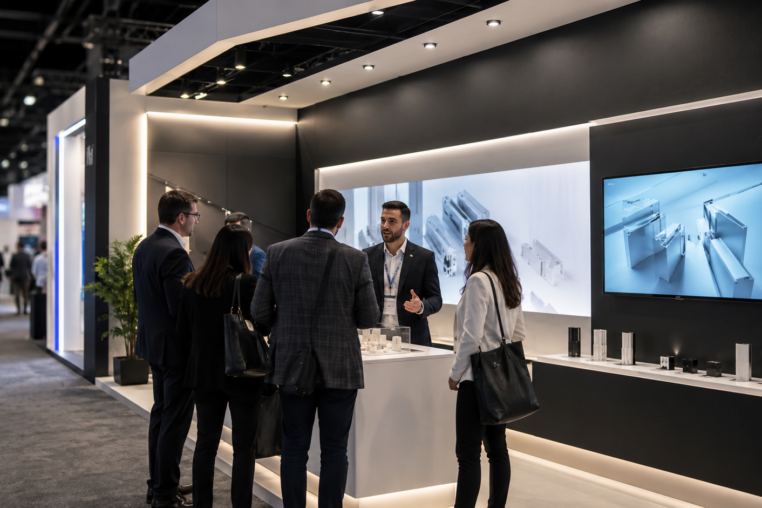
- Invest in tension fabric lightboxes and hanging signs. Backlit graphics create a vibrant, professional look that stands out under convention hall lighting. Hanging signs act as beacons, visible from across the venue.
Technology Integration
Digital elements add movement and interactivity to your booth, which naturally draws the eye. Video walls, touchscreen displays, and rotating product demos give passersby a reason to look closer. Bold visuals supplemented with digital displays showing product features or testimonials can turn walk-by traffic into walk-in traffic.
Through working with exhibitors across industries at Xibit Solutions, we’ve found that the booths pulling the most traffic combine strong physical design with at least one interactive digital element. A static booth can look polished, but a booth with motion on screen and activity inside creates a sense that something is happening worth checking out.
Engagement Tactics That Keep Visitors Longer
Getting attendees into your booth is half the battle. The other half is keeping them there long enough to have a meaningful conversation. According to trade show research, 74% of attendees say a conversation with a booth representative meaningfully increases their likelihood of making a purchase. Every extra minute a visitor spends at your booth improves your chances of converting that interaction into a qualified lead.
Live Demos and Product Launches
92% of trade show attendees come specifically to see new products and innovations. If you have something new to show, the trade show floor is the place to show it. Live demonstrations give attendees hands-on experience with your product, answer questions in real time, and create a crowd that attracts even more visitors.
One survey found that 87% of respondents would skip a show entirely if no exhibitors had new or updated offerings. If you are launching a product in the next quarter, build your show strategy around that launch.
Gamification
Interactive games, trivia, spin-the-wheel contests, and skill challenges related to your industry create energy and draw crowds. They also give your team a natural opening for conversation. The key is tying the game back to your product or service so the interaction stays relevant and memorable.
AR/VR Experiences
Augmented and virtual reality demos let attendees experience products that are too large, complex, or abstract to bring onto the show floor. A VR headset can transport a visitor inside a construction project, a medical facility, or a product assembly line. According to MeetingTomorrow, 55% of shoppers find AR more exciting than traditional displays, and 40% say they would pay more for a product they could experience through AR first.
These experiences also produce shareable content. Attendees filming VR demos or posting AR screenshots extend your brand reach to their social networks.
Comfort and Hospitality
Sometimes the simplest tactics are the most effective. A phone charging station, a coffee bar, or a comfortable seating area gives attendees a practical reason to stop at your booth. MeetingTomorrow calls a free charging station “the perfect way to attract attendees” because it creates goodwill and natural dwell time. While they charge, your team can start a conversation.
| Strategy | What It Does | Best For |
|---|---|---|
| Live demos and product launches | Hands-on product experience; draws curious crowds | Companies with new or updated products |
| Gamification (trivia, contests) | Creates fun, memorable interactions; generates buzz | Lead capture and booth energy |
| AR/VR experiences | Immersive product exploration; produces shareable content | Complex or large-scale products |
| Charging station or hospitality | Practical convenience; increases dwell time | Brand awareness and organic conversations |
| Show-only discounts and bundles | Creates urgency to act during the event | Direct sales and sign-ups |
Train Your Staff Like They’re Part of the Strategy
Your booth team is the strategy in action. A well-designed booth with a disengaged staff is a waste of floor space. Cvent recommends running role-play scenarios before the show so each team member can confidently pitch, answer questions, and identify high-value leads.
A few specifics that make a difference:
- Position staff in front of the booth, not behind the table. Standing a meter in front of the counter, making eye contact, and smiling invites conversation. Sitting behind a table with crossed arms repels it.
- Pre-book meetings with priority targets. Use event apps and LinkedIn to schedule time with specific decision-makers before the show. Random conversations are fine, but planned conversations with qualified buyers are better.
- Brief everyone on qualification criteria. Not every visitor is a lead worth pursuing. Give your team a simple framework for identifying high-value prospects so they spend their time wisely.
Post-Show Follow-Up and ROI Measurement
The most common mistake exhibitors make is treating the show closing as the finish line. Follow-up speed matters. Cvent advises contacting leads within 48 hours, personalizing each message with references to your specific booth conversations, and thanking them for visiting.
After the initial outreach:
- Segment leads by interest level and send targeted follow-up content (case studies, product specs, pricing) rather than a generic “thanks for stopping by” email.
- Maintain your show hashtag and social channels by posting highlights, tagging attendees, and sharing recap content to extend visibility.
- Track pipeline beyond badge scans. The real measure of trade show success is how many leads turn into meetings, proposals, and closed deals. Tools like RFID tracking and booth analytics can quantify foot traffic and dwell time, while CRM integration connects those numbers to revenue.
As Event Marketer reported, top exhibitors are shifting how they prove event value by measuring the KPIs that matter to each internal stakeholder, whether that is qualified leads for the sales team, brand impressions for marketing, or deal velocity for leadership.
Make Your Next Show Your Best One
A strong trade show marketing strategy covers every phase: early planning, pre-show promotion, booth design, on-floor engagement, staff preparation, and post-show follow-up. Each element reinforces the others. A great booth means nothing without trained staff. Trained staff cannot do their job if the booth does not draw traffic. And all of it falls apart without timely follow-up after the event.
If you are planning for an upcoming trade show and want a booth that works as hard as your team does, reach out to Xibit Solutions. We handle everything from custom booth design and graphics production to logistics, installation, and dismantling. Whether you are renting a booth for the first time or refreshing a design you have used for years, we will make sure you show up ready to compete.
Call us at (702) 361-7502 or email info@xibitsolutions.com to start the conversation.