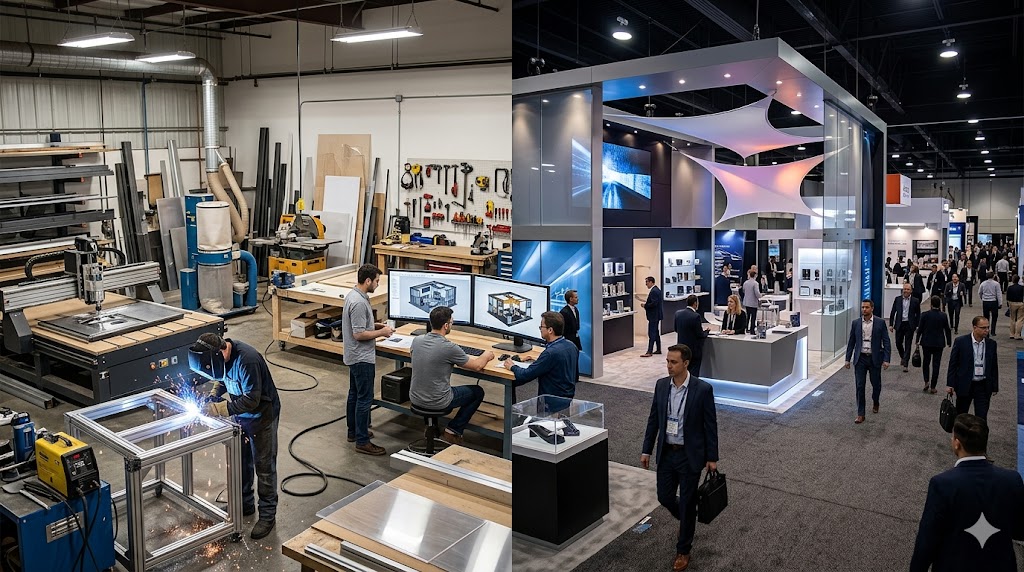
For most companies, outsourcing trade show booth fabrication to a specialized exhibit house is the smarter move. Building a true in-house fabrication operation requires $500,000 or more in equipment and facilities, a full roster of skilled fabricators and designers, and enough show volume to keep that investment earning its keep. Unless you’re running 10 or more major shows per year with consistent, large-format booths, the economics almost never work in favor of building in-house.
At Xibit Solutions, we’ve been fabricating custom trade show exhibits for over 24 years, working with companies across virtually every industry and show format. We’ve seen both sides of this decision play out across hundreds of client engagements. This guide walks through the real costs, the key trade-offs, and a clear framework for deciding which path fits your program.
The Scale of the Decision
Trade shows are a significant investment. The U.S. B2B trade show market hit $15.78 billion in 2024, and the average exhibiting company spends $1.4 million annually on shows. Booth fabrication represents roughly 18% of total show budgets, according to the EXHIBITOR Magazine budget allocation model.
That 18% matters, but it doesn’t exist in isolation. Drayage, labor, logistics, show services, and travel collectively determine ROI. The fabrication decision has to be made in that context.
A few more numbers worth knowing before going further:
- 79% of exhibitors plan to attend the same number or more shows in the next 12 months
- 75% are maintaining or increasing their exhibit budgets
- 81-84% of trade show attendees hold buying authority
- 67% represent entirely new prospects for the companies exhibiting
The stakes of getting exhibit execution right are high. A booth that looks underfunded or poorly executed doesn’t just fail to attract traffic. It actively signals something to those 81% of attendees who are there to make purchasing decisions.
What In-House Fabrication Actually Costs
Most companies that consider in-house fabrication significantly underestimate what it takes to do it well. Here’s a realistic picture.
Equipment
A functional fabrication shop requires industrial CNC routers, which run $50,000 to $300,000 for production-grade machines, with high-end models exceeding $500,000. That’s before accounting for large-format printers, metalworking and woodworking equipment (welders, plasma cutters, bending machines), paint booths, and potentially 3D printers.
Design software adds ongoing cost. Adobe Creative Cloud runs $52.99 per user per month. 3D modeling tools like AutoCAD and Revit run $299 to $2,000 per license annually.
Staffing
| Role | Typical Annual Cost |
| Trade show exhibit designer | $40,000 – $75,000/year |
| Project manager | ~$94,000/year |
| Skilled fabricator / craftsperson | $20 – $38/hour |
| CNC operator | $22 – $40/hour |
| Graphics production specialist | $18 – $35/hour |
Source: ZipRecruiter, Feb 2026
A fully staffed in-house operation needs designers, project managers, carpenters, CNC operators, welders, painters, and graphics specialists. Annual overhead for a mid-size exhibit operation, covering rent, utilities, benefits, insurance, and equipment depreciation, reaches approximately $400,000. That overhead exists whether the shop is running at full capacity or sitting idle between show seasons.
The Fixed Cost Problem
That last point is the central issue with in-house fabrication. Fixed costs don’t flex with your show schedule.
Most companies don’t exhibit year-round. They have peak periods followed by quiet stretches. An outsourced exhibit house absorbs that variability across its entire client base. Your internal shop just sits. You’re paying for the full operation whether you’re building booths or not.
This is one of the most common patterns we hear about at Xibit Solutions when companies reach out after attempting to run their own fabrication operations for a few years. The equipment investment is visible up front. The carrying cost of keeping skilled fabricators on staff year-round, even through slow stretches between show seasons, often isn’t part of the original model.
What Outsourced Fabrication Actually Costs
Custom fabricated booth costs average approximately $2,200 per linear foot, based on EDPA (Exhibit Designers and Producers Association) annual survey data. That includes design, detailing, crating, carpeting, and fabrication, but not graphics.
| Booth Type | Size | Fabrication Cost Range | Notes |
| Portable / pop-up | 10×10 | Under $5,000 | Quick setup, minimal staff |
| Modular system | 10×20 | $8,000 – $15,000 | Multi-show flexibility |
| Custom fabricated | 10×10 | $14,000 – $22,500 | Full design + fabrication |
| Custom fabricated | 20×20 island | $40,000 – $100,000+ | Flagship shows |
| Custom fabricated | Large island (2,000+ sq ft) | Up to $600,000+ | Tech-heavy, architectural |
| Rental | 10×20 | $3,000 – $12,000 per show | No storage cost |
Sources: EDE Corporation, EDPA annual cost survey
Rental exhibits typically cost 25-35% of purchase price per use. That establishes a useful threshold: exhibitors attending three or more shows per year with the same booth configuration should generally consider purchasing. But owning a booth is a very different decision from owning a fabrication shop.
The 5 Cs: A Framework for the Decision
Classic Exhibits, a 30-year exhibit manufacturer, articulated a widely used framework for evaluating this decision: Capacity, Control, Cost, Convenience, and Creativity.
Capacity
An exhibit house maintains production infrastructure sized for continuous multi-client demand. When show season peaks, the house absorbs the load across its client base. An in-house shop hits a ceiling based on its own headcount and equipment. There’s no overflow valve.
Cost
As noted above, in-house overhead is fixed. It exists whether the shop runs 40 hours a week or 4. Outsourcing converts fixed costs into variable costs that scale with actual show activity. For most companies, that’s a meaningful financial advantage.
Creativity
Exhibit houses work across dozens or hundreds of clients and industries simultaneously. That breadth of exposure builds design intuition that no single company’s internal team can match. As one event production firm noted, while an in-house lead might have five years of experience, a full-service partner’s combined team may have 80 years.
Our team at Xibit Solutions works across industries ranging from consumer electronics and automotive to fashion, food and beverage, and firearms and outdoor. That cross-industry exposure regularly produces design thinking that a team focused on a single company’s shows simply can’t access.
Control
In-house fabrication gives you more direct oversight of timelines and quality. You’re not waiting on a third party’s production queue. If you have highly sensitive IP on display, keeping fabrication internal reduces exposure. These are real advantages, but they come at the cost of everything above.
Convenience
Coordinating design, fabrication, graphics, logistics, installation, and dismantling is a significant project management undertaking. A full-service exhibit house handles all of it. That convenience has real dollar value when you price out what it would take to coordinate all those functions internally or across multiple vendors.
Pros and Cons Side by Side
| Factor | In-House | Outsourced |
| Overhead structure | Fixed, regardless of show volume | Variable, scales with activity |
| Equipment investment | $500K+ upfront | None |
| Design expertise | Limited to internal team experience | Cross-industry, multi-client depth |
| Production capacity | Caps at internal headcount | Absorbs demand surges |
| IP protection | Strongest | Managed via NDA and process |
| Quality control | Direct oversight | Dependent on partner selection |
| Logistics coordination | Your responsibility | Typically included |
| Workforce management | Your responsibility | Partner’s responsibility |
| Cost at very high volume | Potentially lower | Higher per-show cost |
Who Should Consider In-House Fabrication
True in-house fabrication makes sense in specific, high-volume circumstances. The general threshold:
- 10 or more shows annually with consistent, large-format configurations
- Annual exhibit budget of $500K or more with capital available for equipment
- Existing internal design and fabrication talent
- Shows concentrated near your headquarters, reducing shipping complexity
- IP-sensitive product displays requiring maximum confidentiality
If you don’t check most of those boxes, the economics won’t support it.
How to Evaluate an Exhibit House
For exhibitors who determine outsourcing is the right path, partner selection becomes the most important decision in the entire exhibit program. As EXHIBITOR Magazine notes, the exhibit house you choose becomes an extension of your brand on the show floor.
Key criteria to evaluate:
In-house production: What percentage of fabrication happens in their own facility? Heavy subcontracting can mean markup layers and reduced quality control.
Pricing transparency: Can they show you a clear breakdown of what you’re paying for? Vague all-in quotes often hide significant add-ons.
Union labor relationships: Major convention cities require union labor for installation. Ask specifically about their established relationships at the venues where you exhibit.
Geographic positioning: A partner based near your primary show markets reduces shipping costs and enables faster on-site response.
Full-service capability: Design, fabrication, graphics, logistics, installation, storage, and post-show support should all be available from a single point of contact.
Portfolio breadth: Look for demonstrated work at comparable scale and across different industries.
One thing worth flagging from the EXHIBITOR research: some exhibit houses hire logistics and other vendors on a client’s behalf and apply a service markup of 30% or more. Ask directly how subcontracted services are priced.
At Xibit Solutions, we produce fabrication and graphics in our North Las Vegas facility, which means no subcontracting markups on production. Our location also gives us direct proximity to major Las Vegas venues, where a large portion of the U.S. trade show calendar runs, including CES, SEMA, and WWD MAGIC. We’ve been building exhibits since 2001, we hold established union labor relationships in the venues where our clients exhibit most regularly, and we handle design, fabrication, graphics, logistics, installation, and dismantling as a single point of contact.
The Hybrid Approach Most Exhibitors Land On
The strongest position for most exhibitors isn’t purely in-house or purely outsourced. It’s a hybrid: an internal exhibit manager or coordinator handles strategic direction, brand governance, and stakeholder communication, while an exhibit house manages design, fabrication, logistics, and on-site execution.
Industry research also points to custom-modular hybrid booths as a common middle ground. Modular frameworks with custom elements provide flexibility across varying booth sizes while keeping costs manageable.
A 2024 exhibitor trends survey reported by TSNN found that 64% of exhibitors want all-inclusive exhibit packages. That number rises to 69% among smaller exhibitors. The preference for turnkey execution is strong and growing.
For exhibitors operating in this model, Xibit Solutions functions as the full-service partner. We take on design, fabrication, graphics, logistics, installation, and dismantling so internal teams can stay focused on brand strategy and stakeholder communication.
Two Factors Shaping the Decision in 2026
Tariff Pressures on Material Costs
2025 tariffs on steel (25%) and aluminum (25%) are pushing fabrication costs higher across the supply chain. EXHIBITOR Magazine’s 2025 Tariff Impact Survey identified this as a significant concern for exhibit managers. Specialized exhibit houses, spreading material costs across a large client base, are better positioned to absorb and manage these pressures than in-house operations with limited purchasing volume.
Rising Technology Requirements
Curved architectural elements alone add 40-50% to fabrication costs, according to EDE Corporation. Tension fabric/SEG systems, transparent OLED displays, CNC-machined precision components, and interactive engagement technology are all raising the technical bar for competitive exhibits. Exhibit houses that invest in this equipment across many clients can amortize the cost in ways a single company’s internal shop cannot.
Material handling at major U.S. venues is billed by hundredweight, with standard rates running $60 to $160 per CWT, and more for oversized or special-handling freight. Exhibit weight is a real cost variable, and specialized houses with experience across hundreds of installations are better positioned to engineer for it.
The Bottom Line
The break-even point for owning versus renting a booth is roughly three shows per year. But owning a booth and running a fabrication shop are two entirely different decisions.
For the vast majority of exhibitors, outsourcing to a specialized exhibit house converts fixed overhead into variable costs, provides access to superior design expertise and production technology, and eliminates the workforce management challenges of maintaining skilled fabricators year-round.
The companies where in-house fabrication pencils out are running large, consistent programs at very high volume. For everyone else, the better investment is finding the right exhibit partner.
Thinking about your next show? We’re happy to walk through your exhibit program and help you figure out the right approach for your specific situation. Consultations and estimates are free.
Phone: (702) 361-7502
Email: info@xibitsolutions.com
Website: xibitsolutions.com/exhibit-services/