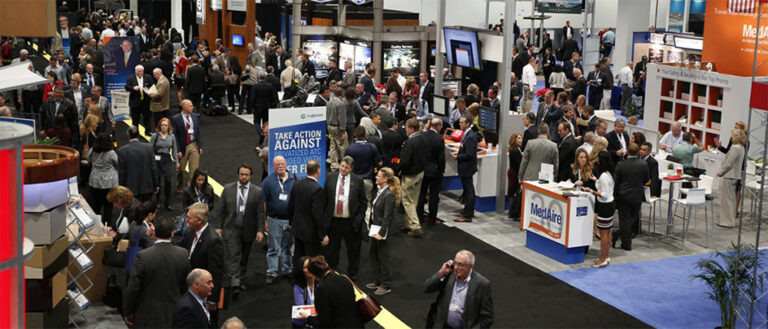
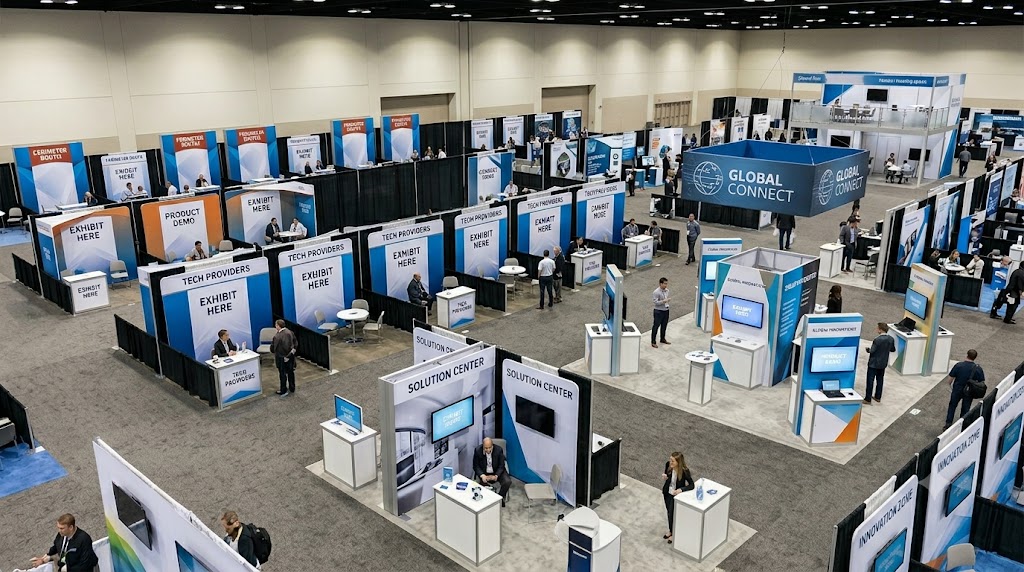
Trade show booths are categorized by how many sides face the aisle and the layout’s footprint. The six main configurations are inline (linear), corner, peninsula, perimeter, island, and double-decker booths, each with different sizes, height limits, and price points. At Xibit Solutions, we’ve designed and built every one of these configurations across hundreds of shows in our more than 20 years in the industry, and the right pick almost always comes down to your goals, your budget, and where the booth sits on the show floor.
This guide breaks down each booth type with sizing, visibility, cost ranges, and the tradeoffs that matter when you’re choosing between them.
What are the main types of trade show booths?
The trade show industry uses six standard booth configurations, classified by how many sides open to the aisle:
- Inline (linear) booths: One side open to the aisle
- Corner booths: Two sides open at the end of a row
- Peninsula booths: Three sides open with a shared back wall
- Perimeter booths: One side open, backed against the hall’s outer wall
- Island booths: Four sides open with aisles all around
- Double-decker booths: Two-story versions of island booths
Show organizers assign these configurations based on your contracted space and where it falls on the floor plan. The configuration determines your visibility, the height limits you can build to, and the design freedom you have within the booth.
Inline (linear) booths
An inline booth sits in a continuous row of back-to-back booths with one side, the front, facing the aisle. The two side walls and back wall are shared with neighboring exhibitors.
The most common inline sizes are 10′ x 10′ (100 square feet) and 10′ x 20′ (200 square feet), though some exhibitors take 30′ or more along a single row. Height limits typically cap at 8 to 10 feet because of neighboring booths on either side.
Inline booths are the most affordable option on the show floor, which is why they’re popular with first-time exhibitors and budget-conscious teams. The tradeoff is visibility: traffic only approaches from one direction, so your front graphic and headline have to do most of the work pulling people in.
When we design inline booths at Xibit Solutions, we put a lot of energy into vertical space, lighting, and a single strong message that reads from across the aisle. Done right, a 10′ x 10′ can punch well above its weight.
Corner booths
A corner booth is an inline booth at the end of a row, with the front and one side open to intersecting aisles. Two walls (the back and one side) are shared with neighbors. Common sizes match inline booths at 10′ x 10′ or 10′ x 20′.
The corner position is meaningfully better than a standard inline. Trade show consultant Lisa Masiello points out that corner booths sit at intersecting aisles, which gives your brand visibility from significantly greater distances than a standard inline. That extra exposure usually carries a small premium over a comparable inline space, but the visibility upgrade is often worth it.
If you’re choosing between an inline and a corner at the same price tier, the corner almost always wins.
Peninsula booths
A peninsula booth, sometimes called an end-cap, is open on three sides (front and both ends) with the back wall shared with one or more inline booths behind it. Peninsula spaces typically start at 20′ x 20′ (400 square feet) and can run larger.
When two 20′ x 20′ peninsulas sit back-to-back, they form what’s called a split-island booth, which is a useful middle-ground option for exhibitors who want island-like presence without the island price tag.
Peninsulas hit a sweet spot. You get high visibility with three open sides, more floor space than an inline, and lower cost than a true island. Industry consultants describe them as a way to get the physical size of an island booth at a reduced cost, with the caveat that one side stays closed.
Perimeter booths
A perimeter booth is an inline booth backed against the exhibit hall’s outer wall instead of another booth. Only the front faces an aisle, so traffic flow is similar to a standard inline.
The advantage is height. Because there’s no neighbor behind you, perimeter booths often allow taller construction than central inlines. Per IAEE display guidelines, perimeter back walls can typically reach 12 feet, compared to 8 feet for standard inline booths. That extra clearance opens up vertical branding opportunities that inline neighbors can’t match.
Perimeter booths are usually the same standard sizes as inline booths (10′ x 10′ or 10′ x 20′). The price is roughly comparable, but the height advantage is a real one if your design wants to go vertical.
Island booths
An island booth is a freestanding exhibit with aisles on all four sides and no shared walls. Island spaces start at 20′ x 20′ (400 square feet) and scale up to 20′ x 30′, 30′ x 40′, 40′ x 40′, and beyond.
Islands are the most visible and flexible booth configuration. Traffic can approach from any direction, hanging signs are typically allowed, and structures can rise to 16, 20, or even 24+ feet depending on venue rules. Industry publications consistently describe islands as the most impressive displays on the floor and the format with the most configuration flexibility.
The tradeoff is cost and complexity. Islands require more square footage, higher construction, more labor for setup, and more design coordination. Through our work at Xibit Solutions, we’ve seen island booths range from straightforward 20′ x 20′ presentations to elaborate multi-zone experiences with demo stages, private meeting rooms, and integrated AV. The format suits major brands, product launches, and any exhibitor who wants their booth to function as a destination on the show floor.
If you’re considering an island for the first time, our trade show booth gallery shows how the same square footage can be used in very different ways.
Double-decker booths
A double-decker booth is a two-story version of an island. The ground floor handles demos, displays, and visitor engagement, while the second story typically houses meeting rooms, hospitality suites, or VIP areas.
Double-deckers are island-sized at the base (20′ x 20′ minimum, often larger) and rise to two full levels of usable space. They effectively double your floor area without requiring more booth footprint, which is valuable in crowded venues where contracted space is the constraint.
The cost reflects the complexity. According to MG Magazine, double-deck island booths average about $237 per square foot for design and production, not counting structural engineering, additional labor, and specialty rigging. They’re built for major brands that need maximum presence and a private upper-level for serious business conversations.
Trade show booth comparison chart
Here’s how the six booth types compare across the dimensions that usually matter most when you’re deciding:
| Booth Type | Open Sides | Common Sizes | Typical Height Limit | Relative Cost | Best For |
| Inline (Linear) | 1 (front) | 10′ x 10′ to 10′ x 50′ | 8 to 10 feet | $ | First-time exhibitors, tight budgets |
| Corner | 2 | 10′ x 10′ or 10′ x 20′ | 8 to 10 feet | $ | Slight upgrade from inline at modest premium |
| Peninsula | 3 | 20′ x 20′ and up | Up to 20 feet (center back wall) | $$ | Exhibitors wanting island feel at lower cost |
| Perimeter | 1 (front) | 10′ x 10′ or 10′ x 20′ | Up to 12 feet | $ | Inline budget with vertical branding |
| Island | 4 | 20′ x 20′ to 40′ x 40’+ | 16 to 24+ feet | $$$ | Major brands, destination booths, launches |
| Double-Decker | 4 | 20′ x 20′ and up | Two stories | $$$$ | Maximum presence, VIP hosting, large teams |
How to choose the right booth type for your show
The right booth type comes down to three questions: what are you trying to accomplish, how much can you spend, and how much visibility do you actually need?
Match the booth to your goals
If your goal is lead generation at a regional show, an inline or corner booth often delivers strong ROI without overspending. If you’re launching a flagship product, hosting press, or competing for attention against major brands, an island or double-decker is usually the better investment.
Set a realistic budget
Booth costs scale dramatically across configurations. Inline and corner booths sit at the low end. Peninsula and perimeter booths fall in the middle. Islands and double-deckers sit at the top. Match the configuration tier to what you can spend, then optimize within that tier for visibility and impact. The cost section below covers specific industry benchmarks.
Factor in visibility and traffic patterns
A 10′ x 10′ inline in a high-traffic aisle near a major draw can outperform a 20′ x 20′ island in a back corner of the hall. Before you commit, look at the show’s floor plan and ask the show organizer about traffic patterns, anchor exhibitors near you, and which aisles tend to be busiest.
This is also a good moment to think about whether to rent or buy. If you’re attending two or three shows a year with the same booth, ownership can pay off. If you’re attending many shows with varying space configurations, renting is usually more flexible and cost-effective.
How much do different trade show booth types cost?
Booth pricing varies based on size, materials, customization, and whether you rent or build to own. Some commonly cited industry benchmarks:
- Inline booths: Roughly $1,000 to $1,370 per linear foot, putting a fully built 10′ x 10′ in the $13,000 to $15,000 range.
- Island booths: Around $135 to $155 per square foot for typical configurations, with some industry data ranging from $117 to $161 per square foot for design and production.
- Double-decker booths: About $237 per square foot on average, plus structural engineering and specialty rigging.
Peninsula, corner, and perimeter booths typically fall between these benchmarks based on configuration and square footage. Perimeter booths usually price similarly to inline booths but may carry a small premium for the height advantage.
These figures cover design and fabrication. Logistics, labor, drayage, electrical services, and show floor fees are typically billed separately. We always recommend getting an itemized quote so you can see exactly what’s included before you commit.
Frequently asked questions about trade show booth types
What’s the smallest standard trade show booth size?
The smallest standard size is 10′ x 10′ (100 square feet), which is most commonly available as an inline, corner, or perimeter booth. This size is the entry point for most trade shows and works well for solo exhibitors or small teams running short demos.
What’s the difference between an island booth and a peninsula booth?
An island booth has aisles on all four sides with no shared walls. A peninsula booth has three open sides and shares its back wall with another booth. Islands offer maximum visibility and design freedom but cost more. Peninsulas give you most of the visibility benefit at a lower price point.
Are double-decker booths worth the extra cost?
Double-deckers are worth it for exhibitors who need maximum presence, host significant numbers of VIP meetings, or want private upper-level space without sacrificing ground-floor engagement. For most exhibitors, a well-designed island booth delivers strong ROI at a fraction of the cost.
What height can I build my trade show booth?
Height limits depend on the booth type and the venue’s rules, but the IAEE display guidelines (which most North American shows follow) set typical maximums:
- Inline and corner booths: 8 feet (some shows allow up to 10)
- Perimeter booths: 12 feet, since there’s no neighbor behind
- Peninsula booths: Up to 20 feet at the center back wall, with line-of-sight restrictions on the sides
- Island and double-decker booths: 16 to 24+ feet
Always confirm with the show’s exhibitor manual before finalizing your design, since the rules vary show to show.
Can I change booth types between shows?
Yes, and many exhibitors do. If you’ve contracted a different space for an upcoming show, you can rent a different booth configuration to fit it. This is one of the main reasons we see exhibitors choose trade show booth rentals over ownership: the flexibility to match the booth to the space.
Ready to choose the right booth for your next show?
Choosing the right booth configuration is one of the most important decisions you’ll make for your trade show program. The six types each have a place, and the best choice depends on your goals, your budget, and the dynamics of the specific show floor.
If you’d like a hand thinking through the decision, we offer free consultations and estimates at Xibit Solutions. Our team has built every one of these booth types across hundreds of shows, and we’re happy to walk through the tradeoffs for your specific situation. Contact us at (702) 361-7502 or reach out for a consultation to get started.