Trade show logistics is one of the most complex parts of exhibiting. Get it wrong, and you’re dealing with delayed freight, surprise fees, and a booth that isn’t ready when the doors open. Get it right, and you walk in focused entirely on connecting with prospects, running demos, and generating leads.
At Xibit Solutions, we’ve coordinated booth shipments, installations, and teardowns at major shows across the country for over 20 years. What we’ve learned is that most logistics problems are preventable with the right planning. This guide covers every phase, from pre-show freight to post-show teardown, with the specific numbers and rules exhibitors need to budget and plan accurately.
Start Planning 3 to 6 Months Out
The most common mistake exhibitors make is treating logistics as a last-minute detail. It isn’t. Carrier rates improve when loads can be consolidated, and most show services come with early-order deadlines that carry real savings.
For large custom exhibits, 6 months is the right planning horizon. For rentals and smaller displays, 3 months typically works. Either way, the moment you confirm your booth space, start the logistics clock.
Pre-Show Shipping and Transportation
Choosing a Carrier
The right shipping method depends on booth size, weight, and how much time you have.
- Ground freight (LTL or full truckload) is the most cost-effective option for heavy or bulky booths when timing allows.
- Air freight is available for smaller shipments or tight timelines but comes at a significant premium.
- Expedited freight is a last resort and priced accordingly.
Whatever carrier you choose, prioritize one with trade show experience and a low claims rate. A custom exhibit is a high-value asset, and damage in transit can mean canceling your appearance or scrambling for a replacement.
How to Package and Label Your Freight
Every crate, pallet, and box should include a label with:
- Trade show name
- Your booth number
- Delivery address and dates
- An on-site contact name and phone number
Remove all old labels before shipping. A mislabeled crate routed to the wrong location is one of the most preventable delays in trade show logistics.
Heavy or fragile components should be crated or palletized. Use airbags and straps to prevent shifting in transit. Pack as if your freight handler has never seen a trade show booth before, because they may not have.
Advance Warehouse vs. Direct-to-Show Delivery
Most major shows offer two delivery options. Understanding the difference affects both your timing and your budget.
| Delivery Method | How It Works | Avg. Material Handling Rate (2015)* |
| Advance Warehouse | Freight is received at a dedicated warehouse before the show, then moved to your booth during setup | $102.88 per CWT |
| Direct to Show | Freight is delivered directly to the convention center during the official move-in window | $96.96 per CWT |
*Source: Exhibitor magazine 2015 industry survey
Advance warehouse delivery is the safer option for most exhibitors. Your freight arrives days before the show, you get confirmation it’s there, and you avoid the gridlock of move-in day truck lines. Direct-to-show saves a few dollars per CWT but leaves no margin for carrier delays. Missing the move-in window results in forced freight charges that quickly erase any savings.
Advance warehouses typically accept shipments up to 30 days before move-in. Ship early.
Freight Insurance
Don’t ship without full-value cargo insurance. Standard carrier liability rarely covers the actual replacement cost of a custom exhibit. The difference in premium is small compared to the cost of rebuilding a booth from scratch with no coverage.
Also build these into your budget:
- Fuel surcharges
- Driver detention fees
- Forced freight fees (charged when a carrier misses the dock deadline)
International Shipments and ATA Carnets
If your exhibit is crossing international borders, an ATA Carnet can eliminate substantial customs costs. Sometimes called a “passport for goods,” an ATA Carnet allows temporary duty-free import and export of exhibit materials between participating countries. A single carnet is valid for one year and covers multiple trips.
Without one, you’ll need a customs broker and potentially a U.S. Importer of Record. Customs complications don’t resolve quickly, so start this process well before your shipping deadline.
What Is Drayage and What Does It Cost?
Drayage, also called material handling, is the fee charged by the show’s official service contractor (general service contractor, or GSC) to:
- Unload your freight from the truck
- Transport it from the dock to your booth space
- Store your empty crates during the show
- Return them at teardown
In the U.S., drayage is mandatory. Exhibitors are not permitted to handle their own freight on the show floor. The official contractor is the only party authorized to move materials in and out of the exhibit hall.
Drayage is billed by hundredweight (CWT), typically with a 300-pound minimum. It is billed in increments, meaning 301 pounds rounds up to 4 CWT. Know your booth weight before you budget.
To put the cost trajectory in context: drayage fees increased 257% between 1996 and 2013, far outpacing labor increases over the same period. It is now one of the largest single line items in a typical show budget, often exceeding the actual freight shipping cost.
Ways to keep drayage costs down:
- Ship within the advance warehouse window to avoid special handling surcharges
- Minimize loose, unpalletized shipments, which often trigger penalty fees
- Consolidate all booth components into as few shipments as possible
- Verify weight calculations against the exhibitor manual before finalizing your budget
Booth Setup and Installation
Union Labor: What Exhibitors Need to Know
Most major convention centers require union labor for specific installation tasks. Union jurisdiction rules vary by show and city, but generally cover:
- Electrical hookups and power distribution
- Overhead rigging and hanging structures
- Flooring and carpet installation
- Heavy structural assembly
- AV equipment setup
Assigning non-union labor to union-jurisdictional work can result in fines or forced rework, both of which cost more than doing it right the first time. Your exhibitor manual will specify what falls under union jurisdiction at your particular show.
Exhibitor-Appointed Contractors (EACs)
If you want to use your own contractor for work within the booth, they must register as an Exhibitor-Appointed Contractor (EAC) with the show organizer, typically 30 to 45 days before move-in. EACs also need to carry required insurance and obtain work badges before arriving on site.
Don’t assume your contractor can show up and work. If they’re not registered and badged, they don’t get on the floor.
Electrical, Rigging, and Overhead Elements
Order all utilities and power well before the show’s service deadline. Late orders cost more, sometimes significantly more.
Any overhead elements, including hanging signs, lighting trusses, and suspended banners, require advance approval from the show organizer and must be installed by authorized rigging crews. On-site rigging ordered after the deadline can carry steep premiums. Map out your total electrical load, outlet placement, and AV requirements before submitting your order.
Venue Compliance and Engineering Approvals
Large island booths often require engineering documentation before move-in. The common threshold is 400 square feet or structures over 10 to 12 feet tall, though requirements vary by show and venue.
Multi-level booths and structures with suspended loads typically require a licensed structural engineer’s stamp. Our installation and dismantling team is familiar with these requirements and handles compliance documentation as part of every project, so it’s not something clients need to navigate on their own.
All booths must also comply with fire codes, ADA accessibility requirements, and any venue-specific restrictions. Common rules include prohibitions on tape or fasteners that damage flooring and requirements to keep certain aisles clear for freight. Violations discovered on move-in day mean required modifications at the worst possible time.
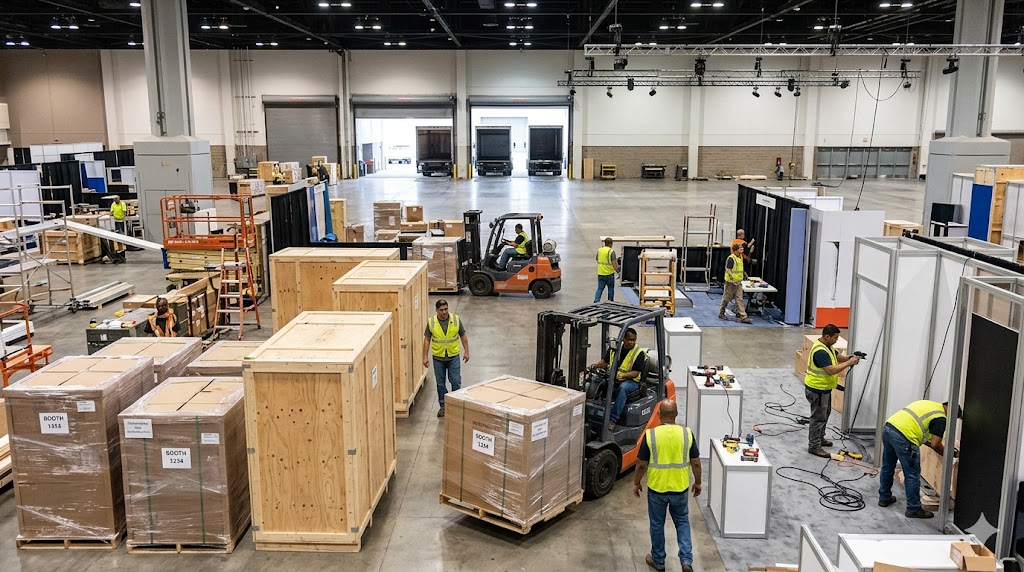
On-Site Move-In Checklist
Assign one person to manage the move-in process. On arrival, they should:
- Check in at the service desk
- Confirm all shipments have arrived
- Activate labor crews
- Affix “EMPTY” labels to crates going into storage
- Verify utilities are installed in the correct locations
- Test all booth equipment before the show opens
Shipment tracking tools let you monitor inbound freight in real time so you’re not waiting at the service desk trying to locate a missing crate.
Teardown and Post-Show Shipping
Dismantling Your Exhibit
Teardown should be planned with the same level of care as setup. Have labels, packing materials, and crates ready before the show closes. Most venues have strict teardown windows and will begin reconfiguring the hall around you if you run late.
Label containers as you pack them rather than waiting until everything is boxed. Teardown operations involving heavy structures, rigging, or suspended loads must be supervised by a qualified person, and this applies whether you’re working with your own I&D crew or the show contractor’s team.
Keep aisles clear throughout teardown for both safety compliance and to allow other exhibitors’ freight to move through.
Material Handling Agreements (MHAs)
Before your freight leaves the show floor, you must complete a Material Handling Agreement for each outbound shipment. The MHA tells the show’s official contractor which carrier will be picking up your freight and where it’s going. Each separate destination requires its own MHA.
Submit all MHAs to the Exhibitor Service Center before the deadline. Without a filed MHA, your carrier cannot legally pick up your crates. Miss this step and your freight may be shipped via forced freight at a premium rate you didn’t choose.
Store Locally or Ship Home?
If you exhibit at multiple shows within a region, local storage is often more cost-effective than shipping the booth across the country between events. Many exhibitors store exhibits near major convention hubs to avoid repeated long-haul shipping costs.
For exhibitors who do multiple shows in Las Vegas, CES, SEMA, MAGIC, World of Concrete, and others, storage at our North Las Vegas facility is a practical option that eliminates a round-trip freight bill between each event. Check our upcoming show calendar to see what’s coming up in your region.
Trade Show Logistics Budget Checklist
Most exhibitors underestimate logistics costs at least once. The categories below are where surprises tend to happen.
| Cost Category | What It Covers |
| Freight / Shipping | Carrier fees, fuel surcharges, cargo insurance |
| Drayage | Material handling from dock to booth and back |
| Union Labor | Installation, electrical, rigging, AV setup |
| Show Services | Carpet, furniture, electrical, internet, AV rentals, lead retrieval |
| Booth Design and Fabrication | Custom build or rental costs |
| Storage | Between-show storage if applicable |
| Travel and Registration | Staff travel, hotel, show badge fees |
| Marketing and Collateral | Giveaways, printed materials, demo equipment |
| Contingency | Buffer for rush orders, overtime, unexpected fees |
Build in a contingency of at least 10 to 15% above your estimated show services and logistics costs. Shows run on tight timelines and surprises are common. A contingency buffer is not pessimism; it’s standard practice for experienced exhibitors.
Common Mistakes That Cost Exhibitors Money
- Shipping too late. Missing the advance warehouse window puts you in the direct-to-show lane with tighter timing and less room for error.
- Skipping freight insurance. One damaged exhibit can cost more than years of insurance premiums combined.
- Poor labeling. Mislabeled shipments get delayed or lost. Label every piece and remove old labels before shipping.
- Not registering EACs in time. Contractors who arrive without advance registration and proper credentials don’t get on the show floor.
- Forgetting the MHA. Without a filed Material Handling Agreement, your carrier cannot pick up your outbound freight.
- Underestimating booth weight. Drayage is billed in CWT increments with a 300-pound minimum. A 301-pound shipment rounds up to 4 CWT. Know your weight.
- Late electrical orders. Rush fees on electrical and rigging can be steep. Order early.
Frequently Asked Questions
What does drayage cover?
Drayage covers unloading your freight from the carrier, transporting it to your booth space on the show floor, storing empty crates during the event, and returning them at teardown. It’s mandatory at U.S. shows and billed by hundredweight (CWT) with a typical 300-pound minimum.
Can I use my own labor to set up my booth?
For simple displays, exhibitors often can. For electrical work, rigging, flooring, heavy structural assembly, and AV setup, union labor is required at most major venues. If you’re bringing your own contractor, register them as an Exhibitor-Appointed Contractor at least 30 to 45 days before the show and confirm they carry required insurance.
How far in advance should I ship my exhibit?
Most advance warehouses accept freight up to 30 days before move-in. Shipping early gives you confirmation of arrival and avoids the congestion of move-in day direct deliveries. Longer shipping windows also translate to better rates, since loads can be consolidated.
What is a Material Handling Agreement?
An MHA is a form you complete at show end authorizing the official contractor to release your outbound freight to a specific carrier. One MHA is required per carrier and per destination. Submit it to the Exhibitor Service Center before your carrier arrives, or your freight may be held.
When do I need engineering approval for my booth?
Island booths over approximately 400 square feet, structures exceeding 10 to 12 feet in height, and any multi-level exhibits typically require structural drawings and an engineer’s stamp before move-in. Requirements vary by show, so confirm the specifics in your exhibitor manual early in the design process.
What is an ATA Carnet?
An ATA Carnet is a customs document that allows temporary duty-free import and export of exhibit materials between participating countries. Valid for one year and multiple trips, it’s the standard tool for international trade show freight. Without one, you’ll need a customs broker and potentially additional bond requirements.
Trade show logistics has a lot of moving parts. If you’re planning your first exhibit or looking to streamline how you handle shipping and installation, get in touch with Xibit Solutions. We handle the full process, from design and fabrication through installation and teardown, so you arrive at the show ready to work rather than solving freight problems.