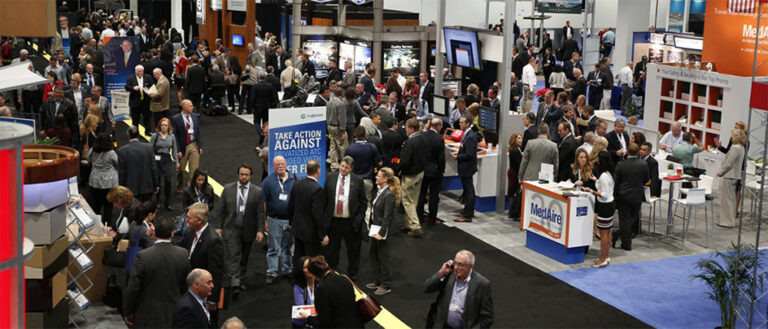
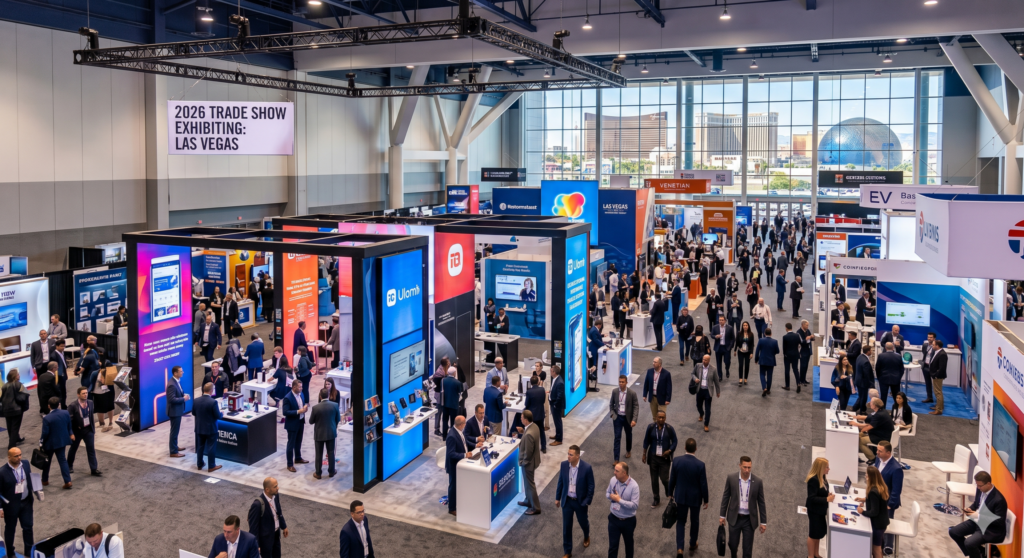
Las Vegas has ranked as the top trade show destination in North America for 26 consecutive years, and for good reason. The city hosts roughly 24,000 meetings, conventions, and trade shows annually, drawing approximately 6 million convention attendees per year and generating $10.1 billion in direct convention visitor spending in 2024 alone. For exhibitors, that scale means enormous opportunity, but also a unique set of logistics, costs, and local rules that can catch unprepared teams off guard.
At Xibit Solutions, we’ve been building and installing trade show exhibits in Las Vegas since 2001, completing more than 2,000 projects across virtually every major show the city hosts, including CES, SEMA, NAB, World of Concrete, and CONEXPO. This guide covers what any exhibitor needs to understand before arriving on the show floor.
Why Las Vegas Dominates the Trade Show Calendar
No other American city comes close to matching Las Vegas as a convention destination. Several structural advantages explain why:
- Hotel inventory: 150,000 hotel rooms, more than any other U.S. convention city
- Airport proximity: Harry Reid International Airport handled a record 58.4 million passengers in 2024, offering nonstop service to more than 150 destinations, and sits just two miles from the Strip
- Convention infrastructure: Nearly 15 million square feet of meeting and exhibit space across dozens of venues
- Climate: 320 days of sunshine per year, eliminating weather-related disruptions common in cities like Chicago or New York
Convention attendees are also high-value visitors. According to LVCVA research, convention delegates spend an average of $1,681 per trip, compared to $1,262 for leisure travelers. That spending power makes Las Vegas shows attractive for exhibitors targeting serious buyers.
Las Vegas consistently leads TSNN’s annual rankings of the nation’s largest trade shows, hosting more top-tier events than any rival U.S. city each year.
The Major Venues
Las Vegas offers more combined convention and exhibit space than any other destination in North America. Three of the continent’s top ten largest convention centers sit within four miles of each other.
| Venue | Total Space | Exhibit Space | Notable Shows |
| Las Vegas Convention Center (LVCC) | ~4.6M sq ft | ~2.5M sq ft | CES, SEMA, NAB, CONEXPO, World of Concrete |
| Mandalay Bay Convention Center | 2.1M sq ft | ~1M sq ft | MAGIC Las Vegas, SuperZoo, Cosmoprof NA |
| Venetian Expo | 2.25M sq ft | ~855K sq ft | SHOT Show, ISC West, G2E, AAPEX |
| Caesars Forum | 550K sq ft | Ballroom-focused | Corporate events, midsize shows |
| Wynn/Encore | 560K sq ft | Meeting-focused | Premium corporate events |
| MGM Grand Conference Center | 850K sq ft | Arena-convertible | Large-scale events |
The Las Vegas Convention Center is the flagship. Its campus spans 4.6 million square feet on 200 acres. A $1 billion West Hall expansion completed in 2021 added 328,000 square feet of column-free exhibition space, the largest of its kind in North America. A $600 million renovation of the legacy halls was completed in December 2025, just in time for CES 2026. The facility also features the Vegas Loop, an underground transit system that moves attendees across campus in roughly two minutes.
In 2024, the LVCC alone hosted 47 conventions with 1.1 million attendees who spent $1.8 billion.
The Biggest Las Vegas Trade Shows
Here’s a snapshot of the major events that make Las Vegas the center of B2B business:
| Show | Industry | Attendance | Exhibit Space | Venue | Frequency |
| SEMA Show | Automotive aftermarket | ~160,000 | 2.5M+ sq ft | LVCC | Annual |
| CES | Consumer technology | 148,000 (2026) | 2.5M sq ft | LVCC + Venetian Expo + ARIA | Annual |
| CONEXPO-CON/AGG | Construction equipment | 139,000 (2026) | 2.9M sq ft | LVCC | Triennial |
| IBS/KBIS (Design & Construction Week) | Homebuilding/kitchen-bath | 124,000 (2025) | 1.2M sq ft | LVCC | Annual |
| MAGIC Las Vegas | Fashion/apparel | ~78,000 | Varies | LVCC/Mandalay Bay | Semi-annual |
| NAB Show | Broadcast media | 65,000 | ~900K sq ft | LVCC | Annual |
| World of Concrete | Concrete/masonry | 57,908 (2025) | 750K sq ft | LVCC | Annual |
| SHOT Show | Firearms/outdoor | 53,000-55,000 | 830K sq ft | Venetian Expo + Caesars | Annual |
The scale of these shows is part of what makes Las Vegas exhibiting both competitive and valuable. Show floors at events like CES and SEMA are visually intense and densely packed. A booth that might stand out at a smaller regional show needs significantly more investment to hold its own here.
What Las Vegas Exhibiting Actually Costs
A useful rule of thumb in the industry is the “Space x3” formula: expect your total budget to be approximately three times your booth space rental cost. That formula holds up well in Las Vegas, where ancillary costs add up quickly.
Booth space rental
Major Las Vegas shows typically charge $20 to $45 per square foot for space only, with no buildout included. Premium shows like CES charge $36-$43 per square foot.
| Booth Size | Space Cost Range | Estimated Total Budget |
| 10×10 inline | $2,000-$5,000 | $6,000-$40,000+ |
| 10×20 inline | $4,000-$9,000 | $12,000-$27,000+ |
| 20×20 island | $8,000-$17,000 | $24,000-$60,000+ |
| 30×30 island | $18,000-$40,000 | $54,000-$120,000+ |
| 40×40+ island | $32,000-$70,000+ | $100,000-$200,000+ |
Exhibit construction
The exhibit itself is typically the largest variable cost:
- Portable/pop-up exhibits: $50-$125 per square foot
- Modular designs: $75-$225 per square foot
- Fully custom builds: $125-$325+ per square foot
- Rental exhibits: approximately 35% of purchase price
How exhibitors allocate their budgets
According to EXHIBITOR Magazine’s most recent survey of nearly 200 event marketers, the average trade show budget breaks down as follows: show services (electrical, internet, material handling, and installation and dismantling labor) account for 18% of spend, followed closely by exhibit design and construction at 16%. Travel and lodging account for 11%, shipping for 11%, marketing and promotions for 8%, and graphic design and production for 6%.
Some line items that surprise first-time Las Vegas exhibitors:
- Electrical service: $500-$1,500 depending on amperage (beyond a single standard 20-amp outlet)
- In-booth internet: $599-$745 for basic shared WiFi; $3,500-$12,000 for dedicated wired connections
- Furniture rental: $30-$60 per piece for basics
- Carpet/flooring: $1-$5 per square foot
- AV/video walls: Can exceed $10,000 for a standard 12-tile installation
- Rigging: Billed by the hour; early-bird rates (~$558/hr) save over $150/hr compared to standard pricing
Build in a 5-10% contingency fund. Unexpected costs at trade shows are the rule, not the exception.
Union Labor: What You Need to Know
Las Vegas is a union labor city for trade shows, and this catches many first-time exhibitors off guard. Four primary unions govern show-floor work at major venues:
- Teamsters: All material handling, including loading, unloading, and transporting freight between docks and booth spaces
- Carpenters (IBCJA): Installation and dismantling of exhibit structures and carpet
- IBEW electricians: All electrical connections, AV installation, and any work involving power
- Riggers: Suspension of overhead signs and operation of heavy lifting equipment
At the LVCC, the General Service Contractor (typically Freeman) is the exclusive provider of all rigging labor.
What exhibitors can do themselves
Exhibitors’ full-time employees may set up their own booths without ladders or power tools, place products on display, and plug into one standard 20-amp outlet. That’s roughly where the DIY option ends.
Using any material handling equipment (including hand trucks and dollies), performing electrical work beyond a basic plug-in, or using power tools triggers union jurisdiction. Violations can result in fines, work stoppages, or removal from the show floor.
Labor rates
Union labor follows a three-tier rate structure:
- Straight time: First 8 hours on weekdays
- Overtime (1.5x): Saturdays and hours beyond 8 on weekdays
- Double time (2x): Sundays and holidays
Since 2017, display, labor, and material handling rates in Las Vegas have increased an average of 29%. Scheduling installation during straight-time hours is one of the most reliable ways to control labor costs.
As our founder Richard Spinella has put it: “We try to make it as easy as possible for our clients to show up and focus on making an impact. The last thing they should be worried about is getting their lighting drops to work or avoiding a $300 fine for some minute thing they overlooked.”
Working with an experienced exhibit partner who maintains active contracts with trade show-approved union laborers takes this complexity entirely off your plate.
Drayage and Shipping: The Hidden Cost of Las Vegas Shows
Drayage is the process of moving your freight from the venue’s loading dock to your booth space. It is one of the most misunderstood costs in trade show exhibiting.
How drayage is billed
Drayage is billed by hundredweight (CWT), meaning per 100 pounds, always rounded up to the next 100. Typical rates range from $60 to $160 per CWT. Most shows impose a minimum charge of 2 CWT (200 lbs) per item, so a 25-pound box costs the same as a 200-pound crate.
A typical 20×20 booth may incur $2,000 to $5,000 in drayage costs alone.
Reducing drayage costs
- Consolidate shipments into fewer, heavier crates rather than many small boxes
- Ship via common carrier (typically 30-40% less than specialized carriers)
- Use the advance warehouse when rates are favorable, and always order early to lock in advance pricing
- Consider renting exhibits locally in Las Vegas to eliminate cross-country shipping altogether
Shipping timelines
- Advance warehouse shipments should be sent two to four weeks before show dates
- Direct-to-show freight must arrive within a narrow move-in window, typically one to three days before opening
- Hanging signs should always ship to the advance warehouse, as they are installed before booth construction begins
Late or misrouted freight doesn’t just create stress. It forces you into overtime labor rates and can push total costs significantly higher.
Fire Codes and Permitting
Permitting and fire regulations for Las Vegas trade shows are governed by the Clark County Fire Prevention Bureau. Key requirements:
- All booth construction and decorative materials must comply with fire codes
- Certificates of flame retardancy (per NFPA 701) must be available for inspectors at all times
- Covered booths exceeding 300 square feet require fire marshal approval
- Booths over 1,000 square feet must have automatic fire sprinklers (with some exceptions for events under seven days)
- Multi-level booths require approval from show management, the GSC, the venue, and the fire marshal
Height restrictions by booth type
Height limits vary by venue and booth configuration. At the LVCC:
- Inline booths: typically limited to 8 feet
- Perimeter wall booths: 12 feet
- Peninsula booths: 16-20 feet
- Island booths: 20-30 feet depending on which LVCC hall
Confirm exact height allowances with your show manual before finalizing any design. We’ve seen exhibitors invest significantly in hanging signs or tall structures only to discover venue restrictions require a redesign.
How to Plan Your Las Vegas Exhibit
Start earlier than you think
For larger booths (20×20 and above), planning should start six to nine months in advance. Even smaller inline booths require a minimum of three to four months of lead time. The complexity of Las Vegas shows, including union coordination, shipping logistics, and permitting, rewards early starters.
Show service orders
Show service orders placed before published early-bird deadlines typically save 25-30% compared to standard or on-site pricing. This applies to electrical, drayage, internet, and labor. These deadlines are firm, and the savings are real.
Booth design on a competitive show floor
Las Vegas show floors are visually intense. Strong vertical elements, bold graphics, and interactive features consistently outperform static displays. Useful design principles for Vegas specifically:
- Account for bright ambient lighting: Las Vegas venues are well-lit, so specify higher-intensity LED lighting and brighter display settings to stand out
- Confirm height allowances before finalizing any structure, hanging sign, or tall element
- Include interactive features: Product demonstrations, touchscreens, and experiential activations drive traffic more effectively than passive displays on dense show floors
- Think about traffic flow: Island and peninsula booth configurations allow visitors to approach from multiple directions; plan your layout accordingly
Pre-show marketing matters
Research indicates that 70% of attendees plan their show visits ahead of time, and 78% already know which exhibitors they want to see before arriving. Companies that run email campaigns, social media outreach, and pre-scheduled meetings with key prospects gain a measurable advantage over those relying solely on booth traffic.
Pre-show marketing should consume roughly 8% of your total exhibit budget.
Staffing and lead capture
Booth staff should be trained to engage passersby, quickly qualify prospects, and capture lead information systematically. The goal on the show floor is qualification, not closing. Post-show follow-up is where most trade show ROI is actually realized. Aim to begin outreach within 48 hours of show close.
The ROI Case for Trade Show Exhibiting
The business case for Las Vegas trade shows is strong when the execution is right. Industry research consistently shows:
- 67% of trade show attendees represent completely new prospects that companies have not reached through other channels (Exhibit Surveys, Inc.)
- 81% of attendees have buying authority (CEIR)
The average cost per lead at a trade show is $112, compared to $259 for a traditional field sales call, making trade shows 57% cheaper per qualified contact. Closing a trade show lead requires an average of 3.5 sales calls, compared to 5-7+ for cold leads.
As Richard Spinella has put it: “As the online business space gets more active, trade shows have become one of the last ways a company can stand out and make a true impact on a person-to-person level.”
The U.S. B2B trade show market reached $15.78 billion in 2024, surpassing pre-pandemic levels for the first time, and is projected to reach $17.3 billion by 2028.
Is the Exhibition Industry Recovering?
Yes, and Las Vegas is leading it. CEIR’s Total Index reached 95.6 in Q4 2024 (with 2019 as the 100 baseline), representing the strongest level of trade show activity since the pandemic and only a 4.4% shortfall from pre-pandemic performance. The exhibitor metric was just 0.1% behind 2019, effectively a full recovery on that measure.
Globally, UFI (the Global Association of the Exhibition Industry) reported 32,000 exhibitions held worldwide in 2024, generating $398 billion in total economic output and supporting 4.3 million full-time jobs.
Frequently Asked Questions
How far in advance should I plan a Las Vegas trade show exhibit?
For booths 20×20 and larger, start six to nine months out. Smaller inline booths need at least three to four months. The earlier you begin, the more options you have for booth design, shipping logistics, and early-bird pricing on show services.
Do I need to use union labor at Las Vegas trade shows?
For most tasks, yes. Las Vegas is a union labor city for trade shows, and four unions govern work on the show floor: Teamsters (material handling), Carpenters (installation and dismantling), IBEW (electrical), and Riggers (overhead hanging and heavy lifting). Exhibitor employees can place products and plug into a standard outlet, but virtually everything else requires credentialed union labor.
What is drayage, and how much does it cost?
Drayage is the process of moving your freight from the venue’s loading dock to your booth space. It is billed by hundredweight (CWT), or per 100 pounds, rounded up. Rates typically run $60-$160 per CWT, with a minimum charge of 2 CWT per item. A 20×20 booth commonly incurs $2,000-$5,000 in drayage alone.
Should I rent or buy a trade show exhibit?
It depends on your show frequency, budget, and storage situation. Renting makes sense if you exhibit occasionally, want different looks at each show, or need multiple booths for simultaneous events. Purchasing makes sense if you attend the same major shows year after year and want to build a consistent brand presence. At Xibit Solutions, we offer both custom builds and rental options and can walk through the math based on your specific schedule.
What booth height is allowed at the LVCC?
It varies by booth type. Inline booths are typically limited to 8 feet, perimeter wall booths to 12 feet, peninsula booths to 16-20 feet, and island booths to 20-30 feet depending on the hall. Always confirm the specific limits in your show manual before finalizing a design.
How much should I budget for a trade show in Las Vegas?
A useful starting point is to budget three times your booth space rental cost. For a 10×10 inline, that’s $6,000-$40,000+ total. For a 20×20 island, plan for $24,000-$60,000+ depending on exhibit complexity and ancillary costs.
Ready to Exhibit in Las Vegas?
Las Vegas trade shows are some of the most competitive and high-value environments in the business world. The companies that succeed treat exhibiting as a strategic investment, starting early, designing with intention, managing logistics carefully, and following up quickly.
We’ve helped exhibitors do exactly that across every major Las Vegas show for over 20 years. If you have an upcoming show and want to talk through options, contact Xibit Solutions for a free consultation and estimate.