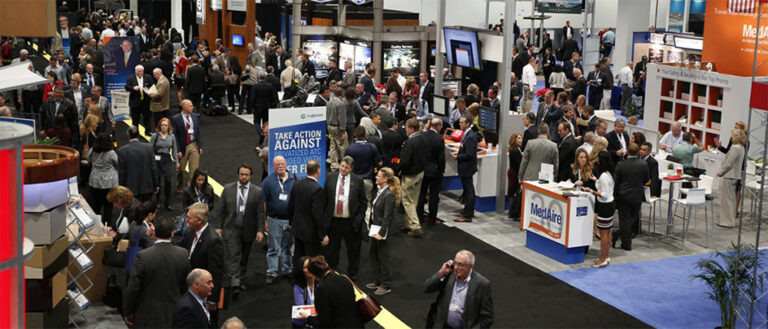
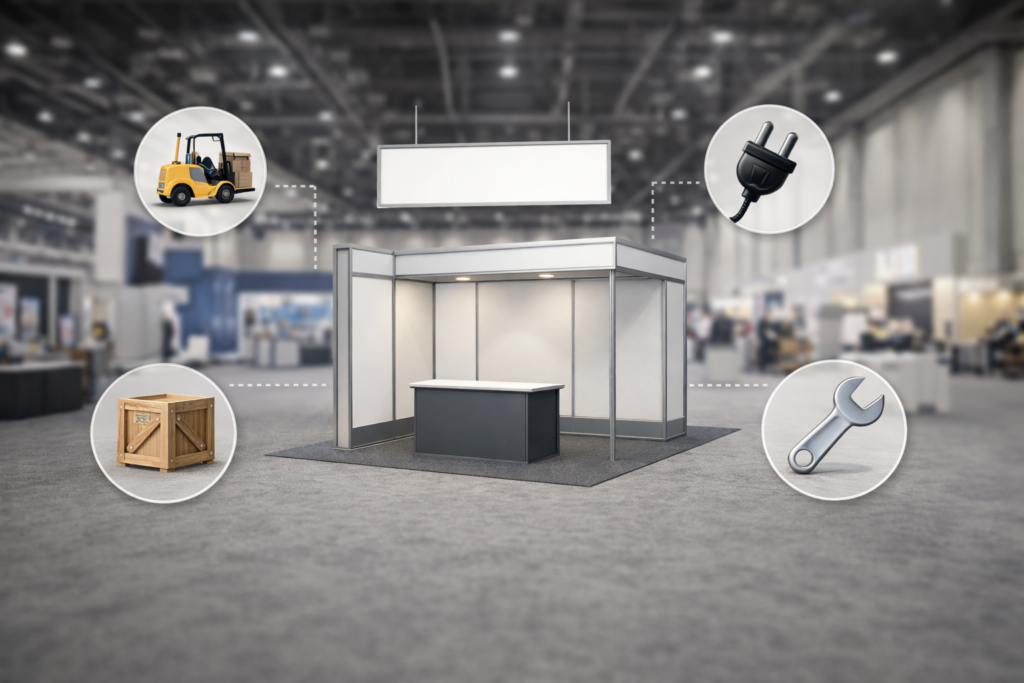
Trade show services fall into two broad categories: offsite services (design, fabrication, storage, shipping, and logistics) and onsite services (drayage, electrical, AV, rigging, and labor). Together, these services consume roughly two-thirds of an exhibitor’s total event budget beyond booth space rental. The U.S. B2B trade show market hit $15.78 billion in 2024 and is projected to reach $17.3 billion by 2028, with roughly 13,000 shows held annually drawing 33 million attendees.
At Xibit Solutions, we’ve coordinated these services for exhibitors at shows like CES, SEMA, SHOT Show, and World of Concrete for over 20 years. The biggest mistakes we see come down to the same thing: exhibitors who don’t know what they’re paying for, or don’t realize a service exists until they get hit with a surprise invoice. This guide breaks down every major service category, what it costs, and how to avoid the most common budget traps.
How to budget for a trade show
Before getting into individual services, it helps to understand how trade show costs are structured overall.
EXHIBITOR Magazine’s widely cited framework puts it simply: total event costs typically run about 3x the cost of booth space rental. A $20,000 booth space translates to roughly $60,000 in total show investment.
Here’s how that budget typically breaks down:
| Budget Category | % of Total | What It Covers |
|---|---|---|
| Booth space rental | 33-35% | Square footage on the show floor |
| Exhibit design and construction | 11-18% | Fabrication, refurbishment, graphics |
| Travel and entertainment | 14-21% | Flights, hotels, meals, client outings |
| Show services | 12-19% | Electrical, cleaning, AV, I&D labor |
| Shipping and drayage | 9-10% | Freight, material handling |
| Promotion and marketing | 6-8% | Pre-show campaigns, giveaways, social media |
| Miscellaneous | 2-5% | Contingency, unexpected costs |
The services beyond booth space rental are where most exhibitors lose money through poor planning or missed deadlines.
Offsite trade show services
The majority of exhibiting success is determined before the show floor opens. Offsite services are the foundation.
Exhibit design and fabrication costs
The booth itself is the centerpiece of any trade show investment. Options generally fall into three categories:
- Custom-built exhibits: Fully bespoke designs using wood, metal, glass, and advanced lighting, built from scratch for your brand
- Modular/reconfigurable systems: Aluminum extrusion platforms (like beMatrix or Aluvision) that adapt across booth sizes and can be reused show after show
- Rental exhibits: Pre-built structures customized with your graphics and branding, ideal for companies exhibiting fewer than three times per year
Costs vary significantly by booth size. Here are approximate all-in figures that include design, fabrication, show services, shipping, I&D, material handling, and electrical:
| Booth Size | Approximate All-In Cost | Cost Per Sq Ft |
|---|---|---|
| 10x10 inline (100 sq ft) | $30,000+ | ~$300 |
| 10x20 inline (200 sq ft) | $50,000-$60,000+ | ~$250-$300 |
| 20x20 island (400 sq ft) | $80,000-$120,000 | ~$200-$300 |
| 30x30+ island (900+ sq ft) | $180,000-$400,000+ | ~$200-$300 |
| 40x50 with heavy tech (2,000 sq ft) | $600,000+ | ~$300+ |
Design and fabrication alone for a standard custom booth runs $15,000 to $50,000+. Budget-friendly modular options come in around $100-$135 per square foot including design, fabrication, crating, and flooring.
A few cost drivers that catch exhibitors off guard. Curved structures add 40-50% to fabrication costs because of CNC machining requirements. Sophisticated lighting setups for a 40×40 booth can run $100,000-$150,000 on their own. And the typical design-to-delivery lead time is 4-6 months for standard booths.
We build everything in our North Las Vegas fabrication facility, which means we control quality, timelines, and costs without outsourcing markups.
Trade show graphics production
Graphics are what make your booth unmistakably yours. This includes backwall displays, hanging sign graphics, banner stands, floor decals, lightbox graphics, and dimensional lettering.
The key decisions come down to substrates and printing methods:
- Fabric: Stretch fabrics for tension systems, dye-sublimation for vibrant color
- Vinyl: Adhesive vinyl for wraps, banner vinyl for hanging elements
- Rigid materials: Foam core, PVC, acrylic, aluminum composite for dimensional pieces
- Specialty: Mesh for outdoor use, backlit materials for lightboxes
One advantage of working with an exhibit company that handles graphics in-house is mid-show flexibility. If a graphic gets damaged or you need a last-minute change, having production capabilities nearby means you’re not scrambling to find a local print shop at 10 PM.
Exhibit storage and warehousing
Between shows, your exhibit needs professional warehousing. That means climate-controlled, secure facilities with inventory tracking and inspection capabilities.
Storage costs typically run $0.45-$0.60 per cubic foot per month, or about $1.50 per square foot monthly. Pull-and-prep services (full warehouse setup, inspection, repair, and re-crating before each show) add roughly $1,500 per show for a 10×10 custom exhibit.
Good storage goes beyond putting things in a warehouse. The best storage partners maintain your booth between events: touch-up painting, replacing worn components, testing lighting and electrical systems, and keeping everything show-ready so it looks fresh every time it ships out.
Trade show shipping and freight
Shipping represents approximately 10% of the total trade show budget.
Domestic shipping for small to medium booths runs $500-$2,000. Larger custom exhibits cost $2,000-$10,000+. International shipping can easily exceed $10,000.
The main shipping methods:
- LTL (less-than-truckload): Most common for trade show freight
- FTL (full truckload): For large or sensitive displays
- Small parcel: Last-minute items only
- Advance warehouse: Ships to a centralized facility before the show for more scheduling flexibility
Strict delivery windows and targeted move-in times make timing critical. Missed deadlines can trigger surcharges of up to 50%. Knowing which shows have tight windows, which advance warehouses are reliable, and how to time shipments to avoid penalties is something that takes years of experience to learn.
Installation and dismantle (I&D) labor
I&D labor is heavily governed by union jurisdictions in major convention cities. Different unions control different tasks. Carpenters handle uncrating and assembly. Electricians manage all wiring. Riggers handle overhead work. Teamsters move freight. Stagehands manage theatrical AV.
Union labor rates run $125-$475 per hour depending on city, specialization, and timing. Overtime rates can reach double standard rates. A 4-hour minimum call is standard, meaning even a 30-minute task gets billed for four hours.
The consequences of getting this wrong are real. Union regulation violations mean penalties. Inexperienced crews mean delays. And an exhibit that isn’t properly installed can create safety issues that shut you down before the show starts.
We maintain active contracts with trade show-approved union laborers across major exhibition cities. Our supervisors direct installation using detailed design plans, so every component goes exactly where it should.
Pre-show marketing
This is consistently under-invested. CEIR data shows 75% of attendees already know which booths they want to visit before arriving at the show. Yet marketers devote only about 5% of event budgets to pre-show promotions. Only 10-15% of exhibitors invest meaningfully in pre-show outreach.
The numbers make a strong case for changing that. 91% of exhibitors who set measurable pre-show marketing goals reported their efforts met or exceeded expectations.
Email campaigns, social media outreach, appointment scheduling, and direct mail should begin 1-3 months before the event. The best booth in the world won’t help if nobody knows you’re there.
Onsite trade show services
Once your exhibit arrives at the venue, a different set of services kicks in. Show services account for 12-19% of the total budget, and they’re where most surprise costs live.
What is drayage and how much does it cost?
Drayage is the movement of your exhibit freight from the loading dock to your booth space, storage of empty crates during the show, and the reverse at close. It’s managed exclusively by the show’s General Service Contractor, and the rates are non-negotiable.
Rates range from $60-$160 per CWT (per hundred pounds) nationally. In expensive cities like New York and Chicago, rates can hit $200-$400 per CWT. Weight is always rounded up to the next 100 pounds, with minimum charges of 200-300 pounds per shipment.
The financial impact is significant. According to EXHIBITOR Magazine, drayage costs increased 257% between 1996 and 2013, while I&D labor costs rose only 21% over the same period. Drayage fees can consume up to one-third of total show expenses.
Here’s a practical example of why consolidation matters. Shipping five separate 25-pound boxes with a 200-pound minimum per shipment costs $1,000 at $100/CWT. Consolidating those same items into one 408-pound crate costs $500. Same stuff, half the cost.
Special handling for uncrated, blanket-wrapped, or oversized items adds a 30%+ surcharge. This is why professional crating and packing isn’t just about protecting your booth. It directly affects your drayage bill.
Trade show electrical services and costs
Electrical power is the first step of booth setup. It must be installed before flooring, which must be laid before structure assembly. Get the order wrong and everything backs up.
Standard 500-watt/5-amp outlets run $100-$200 at advance rates. At on-site rates, the same outlet climbs to $200-$350. Higher-amperage services (20A-100A at 208V or 480V) range from $400 to $2,000+.
In 2024, electrical rates saw the largest year-over-year price jump among all show services, increasing 16.7% according to The Exhibitor Advocate’s Annual Survey. All electrical work must be performed by union electricians in union venues, with no exceptions.
The biggest savings here come from ordering at advance rates (sometimes 30-50% less than on-site pricing) and knowing exactly what your booth requires before you get to the venue.
AV and technology rentals
AV has moved from optional to baseline expectation. Monitor rentals range from $50-$500 per day depending on size. Full AV packages for booths run $1,500 to $15,000+ depending on complexity.
LED video walls, interactive touchscreens, and sound systems command premium pricing and require union labor for installation. Third-party AV providers often offer significant savings over the show’s official AV contractor. Just confirm they can access your booth space and comply with venue requirements before booking.
Lead retrieval technology costs $100-$800 per device per event. Enterprise platforms with CRM integration and real-time lead scoring sit at the higher end. Given that 80% of trade show leads are never followed up on, investing in proper lead capture is one of the highest-ROI decisions you can make at a show.
Furniture rental at trade shows
Shipping your own furniture incurs drayage charges and damage risk. That’s why furniture rental is nearly universal at trade shows.
Basic packages (tables, chairs, counters) run $800-$1,500 from the show contractor. Individual chairs typically cost around $150 each. Basic tables run about $300. Specialty lounge furniture starts at $2,500+ for a complete seating area.
Third-party rental providers deliver directly to the booth with no drayage charges. That can represent meaningful savings, especially for larger booths.
Rigging costs for hanging signs
Rigging is the overhead suspension of hanging signs, banners, and lighting structures. It’s one of the most effective ways to increase visibility across a crowded show floor.
Installation rates run $557-$725+ per hour with one-hour minimums. Structures exceeding 500 pounds require review and stamp by a licensed structural engineer (approximately $450+).
The investment is usually worth it for island booths. A hanging sign acts as a beacon that draws attendees from across the hall, maximizing visibility without consuming floor space.
Flooring, internet, and other venue charges
A few more onsite costs that add up quickly:
- Flooring: $2-$5 per square foot for basic carpet tiles, $6-$12 for hardwood or laminate
- Cleaning: Approximately $0.40 per square foot per day
- WiFi: $200-$500 for basic connections, $7,000-$12,000 for dedicated wired internet needed for demos and streaming
These venue utility charges are the top cost complaint cited by 72% of exhibitors.
Why 80% of trade show leads never get followed up
This statistic, documented by CEIR, is the most expensive problem in trade show marketing. In one experiment, 85% of exhibitors never followed up when a prospect specifically requested contact. Of the 15% who did respond, some took over 50 days.
Meanwhile, 50% of trade show buyers choose the vendor that responds first with relevant information.
The optimal follow-up window is 24-48 hours post-event. The playbook for top performers:
- Designate a “lead sheriff” at the booth for real-time qualification
- Integrate lead capture directly with your CRM (Salesforce, HubSpot, etc.)
- Segment leads by quality for personalized follow-up
- Assign a dedicated follow-up manager who doesn’t attend the show and can begin outreach immediately
It takes 3.5 sales calls to close a trade show lead versus 4.5 calls without prior show interaction. Your booth can be flawless, but if your follow-up process is broken, you’re leaving money on the show floor.
Trends changing how exhibitors spend in 2026
Several shifts are worth watching as you plan your trade show program.
Commerce over experience. According to Freeman’s 2025 Trends Report, commerce has overtaken experience as the top reason attendees visit events. Some 96% of respondents said hands-on experiences made it easier to advocate for purchase decisions internally. This means booths designed primarily for engagement need to also support buying decisions.
Sustainability gaining traction. 54% of organizations now integrate environmental considerations into event strategies. Modular exhibit systems using recycled aluminum and biodegradable fabrics offer the dual benefit of environmental responsibility and reduced shipping weight, which directly lowers drayage costs.
Demand for all-inclusive packages. 64% of exhibitors want exhibit packages inclusive of all costs, rising to 69% among small exhibitors. The trend toward bundled pricing reflects frustration with managing a dozen separate service vendors and invoices.
Modular over custom. Modular and reconfigurable exhibits are expected to outpace custom designs in adoption. The same system can flex from a 10×10 regional booth to a 20×30 major installation. That adaptability reduces both cost and environmental impact.
How a full-service trade show partner reduces costs
Working with a single partner that handles design, fabrication, storage, shipping, graphics, and I&D under one roof offers measurable advantages beyond convenience.
A single point of accountability eliminates the coordination burden of managing 5-10 separate vendors. It reduces miscommunication at handoff points. And it enables weight-optimized exhibit designs that directly cut drayage costs.
In practical terms, that means:
- Hitting all discount deadlines to avoid surcharges of up to 50%
- Securing bulk shipping rates
- Professional pull-and-prep that catches damage before it becomes an on-floor problem
- One phone number to call when something goes wrong
At Xibit Solutions, this is how we’ve operated for over 20 years. From initial booth design through post-show storage, every service runs through our team. The model works because it eliminates the gaps where things fall through the cracks. With 95% of exhibitors confirming that exhibitions deliver value no other marketing channel can replicate, the question isn’t whether to exhibit. It’s whether to do it strategically.
If you’re planning your next trade show and want to talk through what services you actually need, we offer free consultations and estimates. Call us at (702) 361-7502 or email info@xibitsolutions.com.