Trade show success for first-time exhibitors comes down to treating your booth as a three-stage campaign with clear objectives, not just “showing up.” Research shows that exhibitors who plan pre-show outreach, design for instant attention, and follow up within 24-48 hours see dramatically better results than those who focus only on booth presence.
At Xibit Solutions, we’ve helped hundreds of first-time exhibitors avoid costly mistakes over our 20+ years in the industry. The biggest difference between successful and unsuccessful first-timers isn’t budget. It’s about whether they define success metrics before the show starts, design their booth to support those metrics, and build a follow-up system that is actually used.
This guide walks you through the entire process, from selecting the right show to converting leads months after the event closes.
Why Trade Shows Still Matter for First-Time Exhibitors
Trade shows remain one of the most cost-effective ways to start qualified sales conversations when executed properly. The cost advantage is compelling. Research from the Center for Exhibition Industry Research found that the cost of an initial face-to-face meeting was $96 via an exhibition lead versus $1,039 without one. Closing a sale costs an estimated $2,188 with an exhibition lead, versus $3,102 without one. This represents hundreds of dollars in savings per prospect.
These numbers aren’t guarantees, but they explain why companies continue to allocate significant marketing budgets to trade shows. The same CEIR research reports that surveyed companies allocated an average of 35.8% of their marketing budget to B2B exhibitions.
The channel works when you treat it as a campaign, not an attendance line item.
Setting Clear, Measurable Goals (What Success Actually Looks Like)
The most common mistake first-time exhibitors make is treating “being there” as the strategy. The best-performing programs treat trade shows as multi-stage campaigns with explicit objectives and measurement.
Success isn’t one-dimensional. Research published in the Journal of Business Research proposes that trade show performance includes multiple dimensions: sales outcomes, information gathering, relationship building, image building, and motivation activities. If you only measure immediate sales, you’ll systematically undervalue the channel and under-invest in post-show conversion.
What First-Time Exhibitors Should Track
Based on industry research, here are the metrics that matter:
| Performance Dimension | Example Metrics | Why It Matters |
|---|---|---|
| Sales | New qualified leads captured; Sales closed within 9 months | Directly ties show investment to revenue |
| Information Gathering | Competitive intelligence gathered; Market trends identified; Customer pain points documented | Informs product development and positioning |
| Relationship Building | Meetings with existing customers; Strategic partnerships initiated | Strengthens existing accounts and opens new channels |
| Brand Awareness | Media coverage secured; Social media reach and engagement; Booth traffic volume | Builds market presence and supports future sales |
CEIR research shows that the most prevalent exhibitor objectives include meeting existing customers (96%), generating new leads (94%), general company promotions (93%), new product launches (86%), and attending specific events (83%).
When measuring success, 78% of executives said a sales metric is the only or most important metric. The most mentioned were new sales leads (38%) and the number of sales closed after the show (28%).
One critical detail: define your counting window. Among executives who use sales closed after the show as their primary metric, 72% said a sale needs to close within nine months of the event. Setting this expectation upfront prevents attribution debates and aligns marketing and sales.
Choosing the Right Show and Booth Location
Show selection is a targeting decision, not an events decision.
Industry best practices recommend selecting a show that attracts your target market and requesting delegate demographics from organizers, including industry and job titles. If you’re unsure whether a show is right for you, attend as a delegate first to assess the audience fit and operational quality before committing to booth costs.
What Makes a Show Worth Your Investment
Ask these questions before signing up:
- Does this show attract decision-makers in my target accounts?
- What percentage of attendees match my ideal customer profile?
- Can the organizer provide attendee demographics and job titles?
- What’s the show’s track record for exhibitor satisfaction and renewal rates?
- Are my competitors exhibiting (a good sign the audience is there)?
Booth Location Matters More Than You Think
Prime locations are typically near entrances, restrooms, or break-out areas where foot traffic naturally concentrates. Corner and end-cap positions give you visibility from multiple angles.
When evaluating booth options:
- Avoid locations hidden behind columns or in dead-end aisles
- Consider sight lines from main traffic flows
- Factor in proximity to competitors (sometimes you want to be near them, sometimes you don’t)
- Understand the difference between linear booths, island booths, and peninsula setups
We’ve seen first-time exhibitors save money by choosing a smaller booth in a premium location rather than a larger booth in a low-traffic area. Traffic density beats booth size almost every time.
When you’re ready to explore booth options, our trade show booth rental services can help you find the right solution for your budget and goals.
Budget Planning: What First-Time Exhibitors Should Expect
Budgets vary by geography, venue, sector, and booth format, but research provides useful benchmarks. CEIR reports that surveyed executives spent between $29,000 and just under $38,000 per B2B exhibition, with a median of $18,500 per event. These 2009 figures are dated but valuable because they show that exhibitors typically manage trade show investment at the campaign level, not at the level of printing flyers.
Hidden Costs That Surprise First-Time Exhibitors
Beyond booth space rental, budget for:
- Booth design and fabrication (or rental costs)
- Graphics and printing for backdrops, banners, and signage
- Shipping and logistics to get materials to the venue
- Installation and dismantling labor (union labor in many venues)
- Utilities such as electricity, internet, compressed air, water
- Furniture rental if not included in your booth package
- Lead capture technology such as badge scanners or mobile apps
- Promotional materials including brochures, giveaways, demo materials
- Staff travel and accommodation for the duration of the show
- Pre-show marketing including email campaigns, social media ads, PR
- Post-show follow-up including CRM setup, email automation, sales enablement
The show investment becomes rational only when lead-capture quality, lead qualification, and post-show follow-up are integrated into a system. Research suggests exhibition-originated leads may require fewer sales calls to close: 54% require three or fewer calls, compared with 61% of non-exhibition leads requiring more than three.
Your Pre-Show Timeline (12 Months to Show Day)
First-time exhibitors underestimate how early decisions lock in cost and quality.
We recommend starting preparation a full year in advance. This timeline isn’t about being cautious. It’s about forcing early clarity on objectives, securing prime booth locations, and avoiding expensive last-minute decisions.
First-Time Exhibitor Planning Timeline
| Timeframe | Critical Actions | Why This Timing Matters |
|---|---|---|
| 12 months before | Select show; Sign contract; Reserve booth space | Best locations and early-bird pricing available |
| 9–10 months before | Define show objectives and KPIs; Assemble show team; Book accommodations | Hotel blocks fill up; Team needs time to prepare |
| 6–8 months before | Design booth concept; Order graphics; Plan pre-show marketing | Fabrication lead times and printing schedules |
| 3–5 months before | Finalize booth design; Order show services (electric, internet, etc.); Set up lead capture system | Venue deadlines for utilities and services |
| 2–3 months before | Staff training; Pre-show outreach to customers and prospects; PR and social media campaigns | Build meeting calendar before arriving |
| 1 month before | Finalize logistics; Confirm shipping; Brief staff on goals and process | Last-minute changes cost 2–3x normal rates |
| Week before | Ship materials; Travel; Final staff briefing | Materials must arrive at advanced warehouse on time |
| Show week | Execute; Capture leads; Hold scheduled meetings | This is what all the planning was for |
| Week after | Initial follow-up; CRM data entry; Team debrief | Speed matters (interest decays rapidly) |
Missing organizer deadlines can severely damage your show presence. Most venues charge overtime rates or rush fees for late service orders. Worse, some services simply won’t be available if you miss the deadline.
Pre-Show Marketing That Fills Your Calendar
Research consistently shows that performance is influenced by pre-show actions, not just what happens on the floor. A study of 124 firms across three international trade shows found that at least one component from each stage (pre, at, and post) affects sales and information-gathering performance.
The goal is to arrive on-site with meetings already booked and a clear reason for the right people to stop.
Pre-Show Outreach Strategies
The International Trade Administration explicitly recommends targeted outreach before the show: email existing customers with your booth number and send marketing collateral to qualified prospects using contact lists obtained through legitimate channels.
| Tactic | Effort Level | Lead Quality Impact | Best For |
|---|---|---|---|
| Email to existing customers announcing booth presence | Low | High (warm relationships) | All exhibitors |
| Direct outreach to target accounts offering scheduled meetings | Medium | Very High (pre-qualified conversations) | B2B with defined target accounts |
| Social media campaign with show hashtag and booth info | Medium | Medium (broad awareness) | Consumer-facing brands |
| PR outreach to trade publications covering the show | Medium | Medium (brand credibility) | Product launches, industry news |
| Work with organizer to access attendee email list | Low-Medium | Medium (depends on list quality) | When organizer offers this |
| Paid advertising targeting attendees (LinkedIn, trade press) | High (cost) | Medium (depends on targeting) | Larger budgets |
We’ve found that first-time exhibitors often over-invest in booth decorations and under-invest in reasons for people to visit. Pre-show outreach is where you build that reason.
Booth Design That Stops Traffic
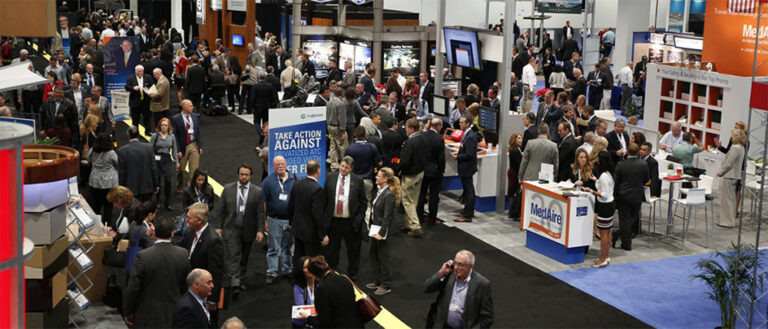
Trade show floors are saturated with competing stimuli. Design elements influence whether visitors notice, stop, and remember your booth.
Eye-tracking research published in the Journal of Convention & Event Tourism tested how visitors fixate on booth design elements, including towers, canopies, furniture, and lighting. The study reports that canopies, towers, and lighting dominated recall over text. People often didn’t remember what the text said.
This aligns with broader research showing that people form impressions in under 0.1 seconds. Your booth should communicate what you do and who it’s for almost instantly, using strong visuals and minimal cognitive load.
Design Principles for First-Time Exhibitors
Use vertical elements to increase visibility. Hanging signs, tall structures, and towers help attendees spot your booth from across the hall.
Create open, inviting entry points. Avoid putting tables or barriers across the front of your booth. Make it easy for people to walk in.
Limit text to 5-7 words maximum. Your main message should be readable from 20 feet away in under 3 seconds. If someone has to stop and read to understand what you do, you’ve already lost them.
Design for one primary focal point. Whether it’s a product display, demo station, or video wall, give visitors one clear place to look first.
Use lighting strategically. Proper lighting draws eyes to products and creates ambiance. Backlit elements and LED systems are particularly effective.
Incorporate interactive elements when appropriate. Touchscreens, product demos, VR experiences, or simple hands-on displays increase engagement time and memorability.
At Xibit Solutions, we design booths that support stopping behavior rather than passing behavior. The difference comes down to sight lines, entry points, and making your value proposition obvious at a glance.
Staffing Your Booth for Maximum Engagement
Great design gets people to stop. Staff behavior determines whether they engage.
The International Trade Administration’s practical guidance is blunt about behaviors that attract engagement: stand rather than sit, stage conversations so passersby can see the interaction, and never leave the booth unattended.
These are low-cost changes that address a real first-time risk: investing in booth design but failing to address the human layer that generates actual leads.
How Many Staff Members Do You Need?
A common rule of thumb is 50 square feet per staff member. This translates to:
- 10′ × 10′ booth (100 sq ft): 2 staffers
- 10′ × 20′ booth (200 sq ft): 4 staffers
- 20′ × 20′ booth (400 sq ft): 8 staffers
This isn’t a universal standard, but it’s a concrete starting point for scheduling rotations so your booth is never empty and your staff aren’t exhausted by mid-afternoon.
Booth Staff Behaviors That Work
Engage visitors with open-ended questions. Instead of “Can I help you?” try “What brings you to the show?” or “What challenges are you trying to solve?”
Stage demonstrations on a schedule. Scheduled demos create natural gathering points and give people a reason to return at a specific time.
Qualify prospects quickly but politely. Not every visitor is a prospect. Develop a 30-second qualification process to focus your time on high-value conversations.
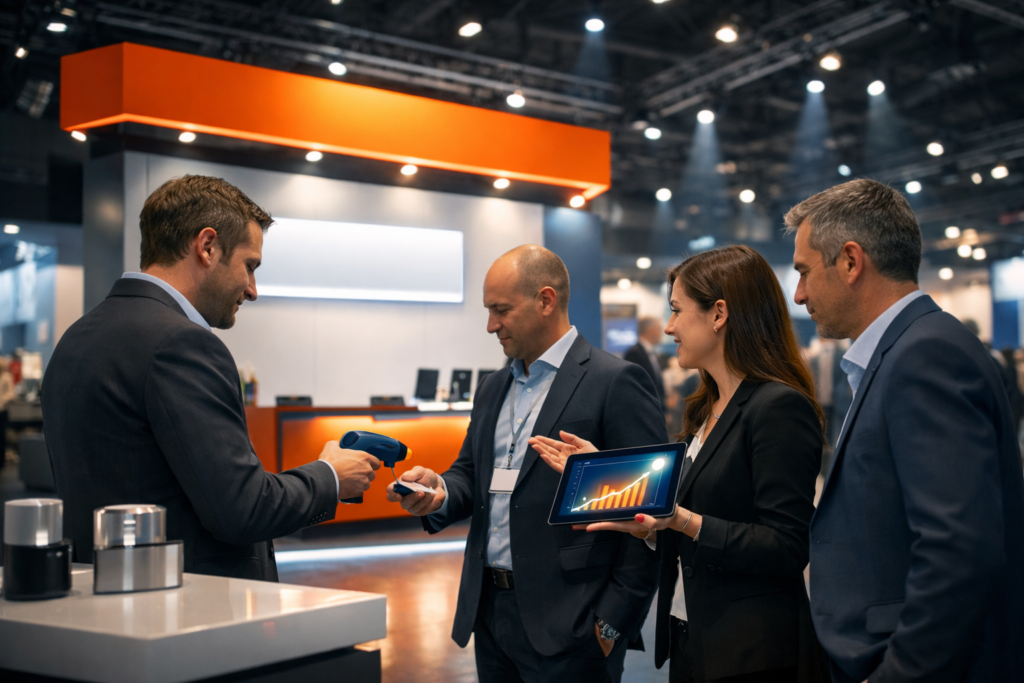
Take good notes. Badge scanners capture contact info, but they don’t capture context. Note the problem discussed, timeline, and specific next step for each qualified lead.
Commit to specific next steps. “We’ll follow up” is vague. “I’ll email you Thursday with that case study” is specific and creates accountability.
Staff Training Is Not Optional
Research consistently treats booth staff training as a first-order driver of performance, not an optional extra. Academic research on trade show performance includes booth staff training among staged activities linked to performance dimensions.
Train your team on:
- Show objectives and target metrics
- Qualifying questions that identify good-fit prospects
- Key messages and product positioning
- Lead capture process and CRM fields
- Data compliance requirements
- Schedule and rotation planning
We’ve seen well-trained staff in modest booths outperform untrained staff in expensive setups. The human factor matters more than most first-time exhibitors realize.
Our installation and dismantling services ensure your booth is set up perfectly so your staff can focus entirely on engaging visitors rather than troubleshooting setup issues.
Lead Capture and Data Compliance
Many first-time exhibitors over-focus on giveaways and under-focus on capturing identifiable contacts with clear next steps.
The International Trade Administration explicitly states: “Raffles are better than hand-outs.” The reasoning is practical. People take small giveaways without engagement, but a raffle attracts traffic and yields a contact list for the cost of the raffle item, especially when badge scanning is used instead of business cards.
Lead Capture Methods
| Method | Pros | Cons | Best For |
|---|---|---|---|
| Badge scanners | Fast; Accurate; Integrates with CRM | Requires equipment rental; May not capture context | High-traffic booths |
| Mobile app scanning | Convenient; Staff use own devices | Requires app setup; Data sync can be clunky | Smaller teams |
| Business card collection | Universal; No technology needed | Manual data entry; Easy to lose cards | Backup method only |
| Raffle entry forms | Attracts traffic; Captures contact permission | Manual entry unless digitized | Consumer shows or traffic-building |
| Direct CRM entry | Immediate; Includes conversation notes | Time-consuming during conversation | Low-volume, high-value leads |
Whatever method you choose, design your lead capture process around the follow-up system you can actually execute. If you scan 500 badges but have no way to segment, score, or act on them, you’ve wasted the effort.
Data Compliance for Badge Scanning
If you collect business contact data from badges or forms, you’re processing personal data and must handle it lawfully.
In the United States, while there’s no single federal data privacy law equivalent to GDPR, various state laws and industry regulations apply. California’s CPRA, Virginia’s CDPA, and similar laws in other states require businesses to be transparent about data collection and provide opt-out mechanisms.
For B2B marketing at trade shows, you should follow these compliance principles regardless of which state laws apply to your business.
Practical Compliance Checklist for First-Time Exhibitors
- Provide a clear notice at the point of capture about how you’ll use contact information
- Record what you captured, when, and for what purpose
- Include an easy opt-out mechanism in all follow-up communications
- Honor opt-out requests immediately
- Don’t share or sell contact data to third parties without consent
- Comply with CAN-SPAM Act requirements for commercial emails
- Retain data only as long as needed for stated business purpose
This isn’t legal advice. Consult your legal team for guidance specific to your situation and the states where you do business.
Post-Show Follow-Up (Where Most Exhibitors Fail)
The fastest way to destroy trade show ROI is slow follow-up.
Research from MIT’s Lead Response Management study reports that the odds of qualifying a lead in 5 minutes versus 30 minutes drop 21 times. The odds decrease 4 times between 5 minutes and 10 minutes.
While trade show leads aren’t identical to web leads, the underlying principle is the same: interest decays rapidly. Define a speed-to-lead service level agreement for first outreach and stick to it.
Recommended Follow-Up Timeline
| Lead Type | Target Response Time | Follow-Up Action |
|---|---|---|
| High-intent (scheduled meeting, specific need) | Within 24 hours | Personalized email referencing conversation; Specific next step; Calendar invite if appropriate |
| Qualified leads (good fit, expressed interest) | Within 48 hours | Personalized email with relevant resources; Clear next step |
| General interest (scanned badge, limited engagement) | Within 3-5 business days | Templated email with general value proposition; Soft call to action |
| Unqualified (collected for raffle, wrong fit) | Optional | One general follow-up; Remove from active pipeline |
The key is including context from the booth conversation: the problem discussed, timeline mentioned, and specific next step agreed upon. Generic “Thanks for stopping by” emails waste the relationship capital you built on the floor.
Post-Show Activities Beyond Email
Follow-up isn’t just about email sequences. Research frames post-show activities as including follow-up and evaluation as core stages of the program.
Consider these post-show actions:
- Sales handoff meetings where marketing briefs sales on qualified leads
- Customer success outreach to existing customers met at the show
- Content creation based on conversations and questions from attendees
- Competitive intel debriefs to share what you learned about the market
- ROI analysis comparing actual performance to pre-show objectives
- Process retrospective to identify what worked and what to improve
An IAEE white paper argues that, for exhibitors to justify their investment, they must also have a lead follow-up program in place. The paper notes that many exhibitors lack such a program.
Your on-site execution should be designed backwards from the follow-up system you can actually run. If you can’t commit to 48-hour response times, adjust your lead volume expectations or booth design accordingly.
Working With an Exhibit Partner
A complete guide should include guidance on working with an exhibit partner without losing control of strategy.
At Xibit Solutions, we provide custom-built exhibits, design, rentals, and services including installation, dismantling, and on-site support. We’ve been helping exhibitors since 2001, and the most successful partnerships happen when clients bring a clear strategy, and we translate it into physical and operational choices.
What to Brief Your Exhibit Partner
The research-backed way to brief an exhibit partner is to provide inputs that map to performance dimensions: sales, information gathering, relationship building, and image building.
Concretely, give your partner:
- Primary show objectives and KPIs aligned to metrics like new sales leads and sales closed after show
- Target visitor profiles and the must-have conversations you need
- Lead capture method and follow-up SLA so booth design supports your process
- Any compliance constraints around data capture and follow-up communications
- Budget parameters including what’s flexible and what’s fixed
- Timeline and deadlines including both show dates and internal approval cycles
What Your Exhibit Partner Should Provide
A good partner should give you:
- Strategic recommendations based on your objectives, not just what looks nice
- Booth design concepts with 3D renderings that let you visualize before committing
- Transparent pricing with line-item breakdowns and no hidden fees
- Project timeline with key milestones and decision points
- Logistics coordination including shipping, installation labor, and show services
- On-site support during the event for any last-minute needs
- Post-show evaluation to measure what worked and inform future shows
Our preparation guide emphasizes starting early (ideally a full year in advance), reviewing contracts and rules, understanding deadlines, and planning pre-show promotion and lead tracking methods. Missing organizer deadlines can severely damage the show’s presence. This is an operational reality; first-time teams often learn too late.
The value of working with experienced partners is translating vague goals like “increase brand awareness” into concrete design decisions like “20-foot hanging sign with 7-word message visible from entrance.”
Your Next Steps
Trade show success for first-time exhibitors comes down to planning, not budget. Companies that define clear objectives, design backwards from their follow-up capacity, and execute disciplined pre-show marketing consistently outperform those who focus only on booth aesthetics.
The data is clear: exhibition-originated leads cost less to close, require fewer sales calls, and generate measurable business value when the program is designed as a system rather than an attendance line item.
If you’re planning your first trade show and want to avoid expensive mistakes, we can help. Xibit Solutions has worked with hundreds of first-time exhibitors over 20+ years, and we’ve built our approach around the same research and evidence presented in this guide.
Contact us at (702) 361-7502 or info@xibitsolutions.com to discuss your upcoming show. We offer free consultations where we’ll help you think through objectives, booth options, and realistic timelines, whether or not you end up working with us.
Start planning early, measure what matters, and treat your booth as a campaign with clear stages. That’s how first-time exhibitors turn a significant investment into measurable returns.